Monday, 14 April 2014

Legacy of Greek Political Thought in America

Classical Association Conference 2014: Legacies of Greek Political Thought in America panel, 11-14 April 2014

Working on behalf of the Legacy of Greek Political Thought group, I recently organised a successful panel for the 2014 Classical Association Conference. The challenge was to provide a narrow enough focus that the four papers provided an integrated and coherent narrative, while still appealing to a varied audience of classicists. With that in mind, the panel was focused upon American receptions of Greek political thought, and its aims were to examine and challenge the links between ancient Greek political thought and its modern invocations in the United States.

The Great Seal of the United States (reverse)

The reverse of the Great Seal of the United States is a reminder of the Founding Fathers’ ambition to create ‘A New Order of the Ages,’ unlike any previous society. Yet correspondence between the Founders shows a keen awareness of and engagement with past societies. In ‘Is there space for a Greek influence on American Thought?’ Nicholas Cole (Oxford) considered the American revolutionary period and addressed this paradox head-on. Nicholas argued that Greek history and thought made important contributions to American thinking, and that these help to explain the development of American thought in the early republic. But historians need to move beyond the narrow debate on political borrowings towards an appreciation of the wider multiplicity of ways that early Americans engaged with Greek thought.

Aesop Said So, Hugh Gellert
Vaulting forward to the twentieth century, Sara Monoson (Northwestern) explored contrasting attitudes to antiquity in ‘Classical sources and the promotion of literacy in radical critique: Diego Rivera’s Man at the Crossroads (1933) and Hugo Gellert’s Aesop Said So (1936).’ Her paper focused on the presence of classical imagery in 1930s expressions of radical critique by visual artists.   In his controversial mural for the Rockefeller Center in New York, Diego Rivera used the imagery of damaged yet formidable classical statuary to suggest the corrosiveness of weighty traditions and to question the value of harking back to antiquity. Though sharing his political viewpoint, Hugo Gellert challenged that view of antiquity. He produced books that combine text and illustrations to find other narratives in the sources (chiefly, the figure of Aesop as a view ‘from below’) that were, to him, able to inspire class consciousness and a sophisticated examination of problems like the greed and corruption of the high and mighty.

In the first of two papers looking at the conservative thinker Leo Strauss, Liz Sawyer (Oxford) presented ‘Leo Strauss, in context: Classical Literature as Political Philosophy in 1950s/1960s American Universities.’ She examined how Strauss’ use of classical literature, especially Aristotle, Plato and Thucydides, fitted within the broader context of how political philosophy and Western literature were taught in the 1950s and 1960s. By studying Strauss’ writings in the light of the educational methodologies of his time, Liz demonstrated how Strauss’s legacy as the ‘founding father’ of today’s neoconservative movement developed. In the final paper, ‘The original neoconservative? Leo Strauss’s version of Xenophon’s version of Socrates,’ I argued that Strauss’s interpretations of Xenophon have been overlooked by political commentators seeking to praise or malign the (exaggerated) Straussian influence on American politics. Using Strauss’s commentary on Xenophon’s Oeconomicus as a case study, I argued that Xenophon, a much more deeper and more nuanced thinker than often portrayed by classicists, rather than Plato or Thucydides, is the classical key for unlocking Strauss’s political ideology.

The focus on Greek thought in America gave the panel coherence, whilst differences in the subject matter and methodological approaches of the speakers ensured variety. Each of the other papers gave me fresh insights into my own work, and the discussions which followed were almost as fruitful as the papers themselves (and gave no indication that any audience members might have over-indulged at the previous night’s gala dinner). Having spent the build-up to the conference worrying about my own paper, which passed in a flash, it is only in retrospect that the real benefits of attending a conference like this became apparent – the unexpected connections and the perceptive and creative conversations with fellow delegates made attending this CA conference an enriching experience.

Sunday, 1 September 2013

Final Post - Top Nine DC Sights

Top Nine DC Sights

Ok, it seems a shame to sign off with the rather rushed review of the Free For All Much Ado About Nothing (excellent though it was), so here is my final post on DC, written in the comfort of my living room in England. This final list of DC sights includes those that were not covered in my other reviews or, mostly, covered in the post on the sights explored when my family visited.

1)  The Library of Congress – this has already been mentioned  in my ‘family sights’ post, but it gets in twice because I’ve been working there, and it really does have some great artefacts that I didn’t mention before. Even beyond the great works from America’s earliest days, the Library also displays some incredibly important global books – like the Gutenberg Bible, the first great book to be printed, which sits in the Great Hall opposite the Giant Bible of Mainz, the last of the great handwritten books from the days before printing. And the Jefferson Building itself is impressive. The Great Hall and the Main Reading Room are worth a trip in themselves.

2) The National Gallery is another wonderful building. The neo-classical architecture can get a bit same-y but the East Building is a modernist marvel, and the interiors of both are perfect, especially the in-door seating/arboretum areas upstairs in the West Building. Art-wise, the dearth of Georges Braque works was a little disappointing but it was made up for by the El Grecos – these really are dazzling. I was walking past their room when I caught a glimpse and then I had to examine them. Hundreds of years ahead of their time, these were the highlight of my visit.

3) The Phillips Collection. A special Braque still life exhibit was on during my visit, which was beautiful. A lot of cubism can be quite depressing, but these works from the late 20s to the 40s manage to be both profound and uplifting. There is also another wonderful El Greco here too. The building was clearly grand as a house but as a gallery it feels almost intimate compared to the National. Well worth a visit.


4) Arlington Cemetery  - I didn’t get to find the grave of Orde Wingate (the man who created the Chindits and led my granddad against the Japanese in Burma in WW2) who is buried there, but a moving trip nonetheless.

5) Ford’s Theatre (where Abraham Lincoln was shot) – great after hours tour by Charlotte Reineck – it’s not a period of history I know much about (and Abraham Lincoln: Vampire Hunter isn’t as much use as you might wish), but this tour was informative enough that I came away knowing a lot more about it, but entertaining enough that I didn’t feel overwhelmed with facts.

     6) Baseball games at the Nationals Park. The really weird thing here, which you would never guess from the mobs of devoted fans attending on a Friday evening, is that DC has only had its own Major League Baseball team for a few years. Before 2005, most Washington residents supported the Baltimore Orioles (and many apparently still do). For somebody, like me, who watches his local cricket team struggle to get a few hundred spectators turn up for a first class match, the fact that so many Americans can get so excited so often (they have around 80 home games a season!) is truly impressive. I watched a mere three of their home games, but each one was lots of fun, although I’m still a little dubious about the nutritional value of the Half Smoke

      7)  Freer Gallery – Asian art is not normally my thing, but this place has such an excellent collection, it is so stylishly laid out and it is such a calm
      and cool pool of tranquillity on a hot DC day, that you cannot help but fall for the pieces on display. The inclusion of western artworks inspired by Asian artefacts, like Whistler's Asian influenced scenes of London, was also
      surprisingly successful. And these beautiful Chinese jade artefacts from the neolithic period were new to
      me.

8) Dumbarton Oaks. This is definitely worth a visit whether you enjoy beautiful old houses, delightfully peaceful and charming English-style country gardens, or wonderfully idiosyncratic museums (a museum focusing only on pre-Columbian American art and Byzantine art doesn’t sound like it would work, but it really does). And it’s in Georgetown, so you can check out one of DCs best areas for shops, bars and restaurants too.


9) Great places for a drink that really should have appeared in House of Cards. The Capitol Hill Club (you’ll need a member to accompany you inside), the Old Ebbitt Grill, and the Teddy and the Bully. Teddy Roosevelt plays a prominent role in the latter two establishments (and there is at least one painting of him in the Capitol Hill Club), including the heads of a bunch of animals he shot in the Old Ebbitt Grill (which makes it sound worse than it is).


So that’s it for my trip to Washington, DC. It hasn’t transformed me into a Renaissance Gentleman, as I had hoped it would, but it’s been a lot of fun and it’s kindled an interest in theatre which I hope to maintain (my first trip to Stratford upon Avon to see some Shakespeare is already booked). As big cities go, Washington is one of the best.

Saturday, 24 August 2013

Week Eighteen, Much Ado About Nothing Redux

24th August 2013, Much Ado About Nothing by the Shakespeare Theatre Company

This will be a short and sweet final instalment of my DC Culture Diary. During my busy final few days, I don't have time for an in-depth review, and this particular play, although not this production, has already been dissected on this blog here. This is probably my favourite Shakespeare play (according to the mother of my theatre companion, it's everybody's favourite Shakespeare play), and all that really needs to be said about this production was that I wasn't disappointed. The Cuban setting made for a raunchy, salsa-filled and passionate production, which managed to seem both novel and traditional at the same time (Sicily being a Spanish-owned island as well, when the original play was set). The comedy was as funny as in Whedon's film, but more impressive for being live, and the biting banter between Benedick and Beatrice both charming and edgy. Recognising an actor from television (Tony Plana, from Ugly Betty) was also a nice bonus. All in all, a great performance, and all the better for being free - after four entries to the Free for All ticket lottery I was just beginning to think I might have to join the queue outside, but my persistence finally paid off.

Now, it's back to England - my next appointment with the Bard will be in his home town for a performance of Antony and Cleopatra by the RSC.


Thursday, 1 August 2013

Week Fifteen, A Midsummer Night's Dream

1st August 2013, A Midsummer Night’s Dream at the Synetic Theater

This is my second visit to ‘DC’s premier physical theater’ so I had a fair idea of what I would be getting. The Synetic’s speciality is wordless theatre, telling stories though action alone. My first visit was for a performance of The Three Musketeers which included some dialogue alongside the dance though, so I wasn’t getting the full-force of the Synetic experience in that show. In that earlier case, the dance/mime aspects were better than the spoken sections, so my expectations for a full dance/mime play were high. Even the thought of seeing a ‘daring’ and ‘innovative’ interpretation of Shakespeare doesn’t cause me the usual fear, for the simple reason that A Midsummer Night’s Dream is one of my least favourite Shakespeare plays. They could have distorted the story as much as they fancied without blighting any beloved memories of mine.

The performance opened in darkness, with unseen dancers moving, seemingly haphazardly, across the stage holding small lights. It was as though a swarm of fireflies were floating frenetically in the night. But as the stage grew lighter, the music took on a tenor suggestive of eastern mysticism, the performers moving like Indian temple dancers and the lights now obviously mini electric candles, evocative of Diwali, the Festival of Lights. Finally, two more dancers emerged, more gloriously arrayed than the others, Titania and Oberon. But Titania as Hindu Goddess. There then follows a bizarre prologue to the play in which we see Puck being born (fully grown) years earlier from a mother who then dies, leaving him to be reared by the faerie monarchs.

Outlandish and captivating so far.

Then the story cut to the more prosaic present, in Athens, where Hermia is due to be married by Duke Theseus to Lysander. But Hermia really wants to marry Demetrius and Hermia’s friend Helena wants to marry Lysander (but he’s seemingly in love with Hermia). So there follows the standard Shakespearean story of the youngsters fleeing into the woods where they are the focus of Puck’s mischievous magic, and all is chaos until the denouement when everybody loves the person they are supposed to love and Theseus agrees to let them all be married. Along the way we have the domestic tiff between Oberon and Titania and the incredibly dull sections with Bottom and his fellow actors. All told without words.

The Synetic is a small theatre and for this show I’d bagged an especially good central second row seat from which to appreciate the physicality of cutting edge dance. I was not disappointed. There are some fantastic uses of movement to create illusion, such as the early section with Demetrius running on the spot and somebody running past him breaking paper doors over him to create the illusion that Demetrius is running through a building and barging through doors (you probably had to be there). Titania and Oberon’s battle over Puck, with the three actors suggesting magical forces at play purely from their own movements, was delightful and stunning. The crowded movement scenes, as in The Three Musketeers, were the most engaging, and another excellent scene was that when the enchanted Demetrius and Lysander were fighting over Helena and fighting off Hermia. There was lots of playfully raunchy humour in that scene too (more Benny Hill than anything actually erotic), which was charming in its knowing innocence. But Puck (Alex Mills), even when alone on the stage, was the real star of the show throughout. Whether climbing up a rope, jumping onto the moon, doing back-flips, contorting himself like a yogi or walking around on his hands, every leap and twist was so natural and, seemingly, effortlessly that one could not help but be impressed. The scene where is was seemingly being pulled all over the stage by a small flower in his hand sounds pretty feeble in description, but actually both funny and beautiful. Really.

Of course, Shakespeare is rightly loved for the power of his words, so you can’t take all the words out and expect every single thing to be hunky dory. For one thing, the performers’ actions have to be extremely obvious to make sure everybody sees them, especially when there are multiple actors on the stage. The jokes were often particularly banal (fart noises, really?), such as depicting Helena’s unrequited longing by having her swig dramatically from an oversized bottle whisky and Hermia overacting when appearing drunk at her engagement party. Shakespeare was at fault for the most tedious, cringe-worthy sections, which were the scenes involving Bottom and the play within a play. These sections are the key reason, for me, that the play doesn’t keep me gripped whoever is performing it. Dull with dialogue, dull without. Nonetheless, there were a number of laugh out loud moments, especially relating to Helena’s attempted wooing of Lysander. The actress playing Helena (Emily Whitworth) has a real gift for comedy.

One of the strongest aspects of the performance was the original score by Constantine Lortkipanidze, who really ought to be scoring major films. The music always added to, and never distracted from, the action. He also had a small part in the cast as the pianist accompanying Bottom’s play, where his musical accompaniment was the highlight (indeed, the only light) of those otherwise dull sections.

Overall, it wasn’t always as funny as I might have liked, but I was still swept along by sheer admiration for the acrobatic feats of dance and movement. For me, this made a bad Shakespeare play watchable. I would love to see a Synetic version of a Shakespeare play that I actually like, but unfortunately I’ll be leaving before the new season begins. The Synetic gives me one more reason to return to DC in the future.

Thursday, 25 July 2013

Week Fourteen, The Book of Mormon

25th July 2013, The Book of Mormon at the Kennedy Center

Mark Evans as Elder Price
I had a few complaints about The Book of Mormon, but these were essentially ethical (see below). Of the key components needed for a good musical – captivating songs, delightful dance routines, a story that keeps you hooked, characters you care about – The Book of Mormon is handsomely kitted out. The songs are not quite up there with the best efforts of Rice and Webber, but then what is nowadays? The song ‘Hello’ is incredibly catchy and gets the show off to a flier, and ‘You and Me (but mostly me)’, a duet between the talented, hardworking Elder Price (Mark Evans) and the lazy, laid back lying Elder Cunningham (Christopher John O’Neill) is also solid. A couple of the better ones were simply comedy copies of other musical hits; for example The Lion King’s ‘Hakuna Matata’ became ‘Hasa Diga Eebowai’ (‘Does it mean no worries?’ ‘No, it means F#!k You, God’), and Annie’s ‘Tomorrow’ morphed into ‘Orlando’ (one of the Mormon missionaries vision for the afterlife involves becoming the god of a new planet based on Disney World). ‘Joseph Smith American Moses’, the African villagers’ version of Mormonism as explained to them by Elder Cunningham, is a hilariously messed up mélange of Mormonism and sci-fi. And Evans is so perfectly cast as the good but soon to be disillusioned, all-American Mitt Romney lookalike that I was surprised to learn later that he’s a fellow Englishman.

But then we come to the shortcomings. I don’t especially like jokes about raping babies or the number of Africans with AIDs, but I accept that my delicate moral qualms are out of sync with our wider culture. If there were any absolute moral standards to cling to such personal discomfort might begin to engender thoughts about Western spiritual decline. But, of course, moral standards are a repressive pre-modern myth. And I’m sure the creators would be disappointed if there weren’t still a few old fuddy-duddies like me around to offend. ‘Pushing boundaries’ has become the key criterion for judging art. Inevitably this means ‘transgressing’ the rules that art should be beautiful and uplifting, and the only way to get a response is to produce something ugly and offensive. So how do you shock the audience? You get everybody chuckling by drawing attention to the incongruity of our images of Africa from The Lion King and the ‘reality’ portrayed here of prevalent AIDs, men raping babies and the mutilation of girls’ genitals. These issues do demand attention (though not necessarily through the medium of musical theatre); but I was also struck by another distasteful, but this time unintended, incongruity: here was an audience of predominantly liberal, progressive types, many having paid $250 a ticket, guffawing at jokes about disease ridden, mutilated Africans.

The overwhelming popular acceptance of The Book of Mormon does reveal something interesting about the extent of hypocrisy surrounding the values of modern progressive culture (because, of course, relativism is really only applied to debunk traditional moral standards). One doesn’t need much imagination to know that if any known conservative had depicted Africans with anything approaching this level of idiocy and depravity, they would have been mercilessly castigated as a racist reactionary. However, because The Book of Mormon’s more obvious target is religion, a perfectly acceptable progressive object of ridicule, the overt liberalism of anti-religiosity earns them a pass on any potential question of racism. The treatment of Africans here is an echo of the contrived controversy last year in America when a conservative talk-show host called a graduate student a slut. This was clearly not a very nice thing to say and it reflected badly on the man who said it (Rush Limbaugh). The storm of abuse Limbaugh received and the line taken by feminists, that the use of that word reflected Limbaugh’s misogynism and the entire Republican Party’s ‘War on Women’, was unsurprising. But that liberal response to Limbaugh would have been more convincing if an equally strong line had been taken when prominent liberal Bill Maher called Sarah Palin a c&*t. Instead, Maher’s textbook liberalism on other issues allows his sexism to be passed over in silence; just as The Book of Mormon’s more obvious send up of religion lends it the leeway to lampoon Africans as well.

But my main criticism of the musical goes beyond nauseating baby-rape jokes, the hypocrisy of politically correct progressivism and even the obvious conclusion that we’re living in the sort of degenerate era usually followed by a dark age. No, the main weakness of the musical is its lack of controversy in its key selling point. Is a satire on religion really especially daring in 2013? Jesus Christ Superstar took some liberties with the Bible and earned some controversy, but that was back in 1967. Monty Python’s Life of Brian was even more evidently a satire on religion, and was banned in a number of cinemas across the world. That was back in 1976, when church attendance and respect for religion were much higher than today. And the religion under attack was Christianity. A satirical musical on Islam would also be daring… but the Mormons? Only a tiny percentage of Americans are Mormons and they have few defenders outside their sect. Atheists and agnostics see it as a joke religion already and even mainstream Christians find them suspect. And unlike certain religions noted for their angry attitude towards perceived insults, Mormons are nice too. There were no Mormon pickets outside the theatre, and the programme actually contains friendly adverts from the Mormon Church pointing out that ‘you’ve seen the play, now read the book!’ The current head of the Mormon Church, Thomas S. Monson, may have once been voted ‘The MostPowerful Octogenarian in America,’ but he isn't in the fatwa-issuing habit, so the cast and creators probably don’t need to go into hiding just yet.

There was plenty of emphasis in the musical about Mormonism being the American religion, created in America and having a uniquely American character. This makes it fair game for attacks from leftist anti-religionists who would normally avoid attacking non-western religions because their anti-religious sentiment in those cases is cancelled out by their anti-western sentiment. We don’t have to imagine how liberals react when non-western religions are insulted because there is a good recent example to hand. In 2011 the American ambassador to Libya and his security team were attacked and killed in an attack originally (mistakenly) attributed to Muslim anger about an internet video produced in America by an Egyptian Copt named Nakoula Basseley Nakoula. This low quality film depicted Mohammed in a very bad light and provoked a good deal of anti-American anger. President Obama was quick to label it a ‘crude and disgusting video’ and he ‘made it clear that the United States government had nothing to do with this video,’ whose ‘message must be rejected by all who respect our common humanity.’ It was also ‘an insult not only to Muslims, but to America as well.’ He went on to add that ‘the future must not belong to those who slander the prophet of Islam.’ He did also point out that America believed in freedom of speech and would not ban the video; however, then Secretary of State Clinton told one of the victims’ parents that the administration would ‘get’ the perpetrators of the video. Despite the video itself breaking no American laws, Nakoula was duly investigated and found to have violated his parole for a former offence and imprisoned for a year. It is hard to escape the conclusion that Nakoula was really locked up to appease Islamic anger. Now, picture an alternate reality where a Republican president had made a similar speech attacking the creators of The Book of Mormon, where the Secretary of State had promised to ‘get’ its creators and where they had been duly ‘got’ and locked away on trumped up charges. There would be a liberal outcry. Islam cannot be attacked, Mormonism can.

There has been no real controversy over The Book of Mormon because they are a weak religion, unpopular with both Christians and atheists, with no defenders. Satire should bring the powerful down to earth. It should be a tool of the weak against the strong, but The Book of Mormon does exactly the opposite. In essence, its creators are bullies, and we, the tittering audience, are their supportive stooges. And this isn’t altered by the fact that Mormonism was such an enticing target because of the apparent wackiness of some of their beliefs (getting your own planet after death, the gold tablet that nobody was allowed to see, the 2,000 year old Jewish civilization in America that has vanished without a trace).

Despite these scruples, I still enjoyed the show. It ends on a happy, and even slightly pro-religious, note. It’s not an endorsement of religion as the truth, but it does portray the Mormons as extremely decent and blissful people (despite the occasional need to repress their un-Mormonic urges), and it does portray religion as something socially useful in backward places (and the Uganda of the musical is definitely a backward place). Essentially, the show shows us that a ‘good’ religion is one which has no regard for the truth but is instead tailored to solve the social problems of the local area. It isn’t exactly an uplifting view of religion but, with the catchy songs, a few great lines, and the joyous finale, it would be difficult for even a curmudgeon like me to leave the theatre without a spring in his step.

Next week,a silent version of A Midsummer Night's Dream at the Synetic Theater

Sunday, 21 July 2013

Week Thirteen, Oscar Wilde's Salomé

21st July 2013 – Oscar Wilde’s Salomé at the Atlas Theater on H Street, DC

Salomé is not Wilde’s usual subject matter. The plot involves the step-daughter of Herod attempting to seduce John the Baptist and then encompassing his death by beheading when John rebuffs her. It was also originally in French, but the differences between Salomé and Wilde’s other plays go far beyond the original languages in which they were written and the contrasting subject matter. Whereas Wilde’s other plays are characterised by their playful, witty, lightness of touch, Salomé is much darker and, dare I say, the dialogue plods rather than frolics. Whereas plays like The Importance of Being Ernest are zany portrayals of pragmatic people, Salomé is symbolic and brooding, full of nightmarish imagery and weird, ominous repetitions. The moon is constantly alluded to and referenced in the dialogue, sometimes as a beautiful ‘silver flower’ or a virgin, but more and more ominously as the play progresses (regresses?) The moon was like a ‘mad woman searching everywhere for lovers’ (like Salomé), or as a pallid herald of death: ‘like the hand of a dead woman, covering her face with a shroud.’

Herod (Brian Hemmingsen) and Salomé (Irina Koval)
Salomé’s dance for Herod isn’t exactly erotic, and one can’t really imagine any genuinely red-blooded man going wild for it, but it is a beautiful, elegant expression of something. Maybe it’s symbolic of eroticism in the abstract. Herod (Brian Hemmingsen) is interesting too. He looks like a Sicilian thug but he talks with the subtlety of the Godfather. Only his leers toward his young step-daughter hint at the animal inside. John the Baptist (or Iokanaan as he is called here) is powerfully portrayed, but his constant shouted interruptions – no doubt symbolic of something or other - are the ultimate discordant mood-killer. The 1920s cocktail party setting makes provides a quality of Wildean sophistication in a roundabout way (well, Noel Coward-ish, which is close enough). But there is also a sort of 1980s vibe as well (and the 1920s setting contributed to that atmosphere – the 20s were big in the 80s). The stilted, symbolic language and stark staging are also in the vein of every BBC 2 arty television play of the 80s. The white face paint symbolically reflected the moon motif, but it also prompted memories of all those Pierrot pictures which were so popular amongst 1980s teenage girls (my older sister had a couple in her room).

So there were interesting aspects and some excellent performances, but I left frustrated.

This is a small theatre with a low budget and a cast of relative unknowns, so it would be easy to blame the shortcomings of this performance, and the disappointment of the viewer, upon the cast and theatre. But that would be a mistake. The strengths here - like the zesty coquettishness of Salomé, the eerie dream quality of the young Syrian - were due to the production. The main weaknesses were the work of Wilde. It is to his credit that he continued to experiment even after the seemingly effortless success of his ‘normal’ plays. But this is really not his best work.

Next week: The Book of Mormon at the Kennedy Center.

Saturday, 13 July 2013

Week Twelve, Much Ado About Nothing

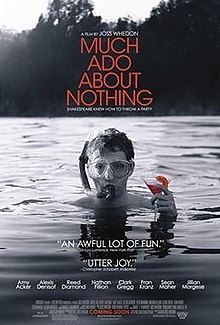
13th July 2013 - Joss Whedon's Much Ado About Nothing at E Street Cinema, DC

MuchAdo.jpgI was quite prepared to be a little sneery about Joss Whedon’s new film adaptation of this Shakespeare comedy. The early 1990s version, starring Kenneth Branagh and Emma Thompson, is my favourite film version of any Shakespeare play. And hearing that it was filmed in a few days in between Whedon’s more important projects, using lesser known actors from some of Whedon’s earlier TV work, implied that this wasn’t really a serious effort. And some of the earlier reviews seemed to be more excited about seeing the inside of Whedon’s home (used as the location) than about seeing a new Shakespeare adaptation (Much Ado about Whedon’s House…) But all of that is unfair on what is really a wonderfully joyous film.
Returning to the play, Beatrice is probably Shakespeare’s best female character – loyal to her friends, witty and strong. She is stranded in a man’s world that she can’t really change, and given the choice between bitter despondency and surrender (or both), she finds a third way combining cool detachment and humour (‘I had rather hear my dog bark at a crow, than a man say he loves me’). And when only a man can accomplish what she needs most (revenge for the ill-treatment of her cousin), she skilfully uses Benedick’s attraction to her to achieve it. Initially she has similarities with the pre-tamed Katherina from The Taming of the Shrew. But where Katherina is ultimately ‘tamed,’ Beatrice is never less than Benedict’s equal (and she often comes off better in their duels). She isn’t Shakespeare’s only strong woman; Portia in The Merchant of Venice is also a powerful, witty character. But Portia marries an idiot, whereas Beatrice and Benedick are matched perfectly. So their ultimate union is therefore much more satisfying. Benedict’s and Beatrice’s will they/won’t they love story might seem a little stale now, purely because it has been the basis of so many modern rom-coms, but there is so much else happening, and the characters are so much more profound than we would see in the average rom-com, that this play still has the power to move us.
So this is great material and that 1990s film adaptation is my idea of Shakespeare film perfection (except for one small drawback, which I’ll come back to). A cast of great actors; Emma Thompson was at her most alluring, Branagh was showing an early glimmer of the less annoying actor he would eventually turn into full-time, and Denzel Washington, Richard Briers, Kate Beckinsale and Brian Blessed added colour and character. The Tuscan setting is also every middle-class English person’s idea of Eden (I’m not middle-class, but I can still dream). Even the inclusion of Keanu Reeves at his most moronic barely detracted from the sheer loveliness of this film.
So Joss Whedon’s version has a lot to live up to. And early reports – filmed at Whedon’s house in only a few days, the lesser known cast - indicated that it might be an amateurish effort. But if it is amateurish, it is amateurish in the best sense in which the term was originally meant. In the Victorian period, the amateurs were the ones who did it for love and passion, whereas ‘professional’ was often a derogatory term, indicating one who put grubby money ahead of art. England’s cricket team was led by amateurs from their first test in 1877 until they appointed their first professional captain in 1952. Of course, such noble ideals didn’t always work out in reality, and the professional/amateur divide, when it is remembered today, is more often recalled as a time when talented working class professionals were demeaned in order to feed the egos of mediocre, entitled aristocrats. But in its noblest sense, in theory as opposed to employment, the cult of the amateur lauded love over money, and joy over seriousness. Which is all a long (long) way of saying that Whedon’s Ado is amateurish in the finest way possible. The acting is excellent, the Shakespearean language is really brought alive, and every twist and turn of that beautiful language is amplified and underscored, without ever being over-acted or dumbed-down. Shakespearian comedy, which, for me at least, is rarely actually very funny, here had the audience laughing throughout.
The use of actors with minor roles in Buffy and Angel was never a drawback because they all played their parts here with panache and aplomb, and their inclusion gave the audience a little bonus whenever they recognised an old favourite (‘Ah, it’s Drusilla the vampire, but with blonde hair’). Alexis Denisof as Benedick is much better without the irritating English accent he adopted in Angel, and Amy Acker (Beatrice here, Fred from Angel) is a revelation – beautiful, fragile, waspish and funny - she really needs to get some much bigger roles after this. The police were a big improvement even on the 1993 film. In Branagh and Thompson’s version, Dogberry was played by Michael Keaton in a manner more annoying than funny. Here, the police were incredibly dumb but still somehow believable, and very funny too. Finally, Whedon’s house is less impressive on the outside than I expected, but it’s very tastefully decorated inside, and the California style gave it a contemporary ‘nearly Italian’ feel that went well with the play’s setting.
This is a feel-good film that shows that ‘upbeat’ and ‘shallow’ don’t have to go together. It is also a celebration of old-fashioned love that leads to marriage. I left the cinema with a spring in my step, and my one regret at the end was that Whedon ‘wastes’ so much of his time making gigantic blockbusters like the Avengers, instead of focusing on his real vocation of making low budget Shakespeare adaptations.