Showing posts with label Washington. Show all posts

Sunday, 1 September 2013

Final Post - Top Nine DC Sights

Top Nine DC Sights

Ok, it seems a shame to sign off with the rather rushed review of the Free For All Much Ado About Nothing (excellent though it was), so here is my final post on DC, written in the comfort of my living room in England. This final list of DC sights includes those that were not covered in my other reviews or, mostly, covered in the post on the sights explored when my family visited.

1)  The Library of Congress – this has already been mentioned  in my ‘family sights’ post, but it gets in twice because I’ve been working there, and it really does have some great artefacts that I didn’t mention before. Even beyond the great works from America’s earliest days, the Library also displays some incredibly important global books – like the Gutenberg Bible, the first great book to be printed, which sits in the Great Hall opposite the Giant Bible of Mainz, the last of the great handwritten books from the days before printing. And the Jefferson Building itself is impressive. The Great Hall and the Main Reading Room are worth a trip in themselves.

2) The National Gallery is another wonderful building. The neo-classical architecture can get a bit same-y but the East Building is a modernist marvel, and the interiors of both are perfect, especially the in-door seating/arboretum areas upstairs in the West Building. Art-wise, the dearth of Georges Braque works was a little disappointing but it was made up for by the El Grecos – these really are dazzling. I was walking past their room when I caught a glimpse and then I had to examine them. Hundreds of years ahead of their time, these were the highlight of my visit.

3) The Phillips Collection. A special Braque still life exhibit was on during my visit, which was beautiful. A lot of cubism can be quite depressing, but these works from the late 20s to the 40s manage to be both profound and uplifting. There is also another wonderful El Greco here too. The building was clearly grand as a house but as a gallery it feels almost intimate compared to the National. Well worth a visit.


4) Arlington Cemetery  - I didn’t get to find the grave of Orde Wingate (the man who created the Chindits and led my granddad against the Japanese in Burma in WW2) who is buried there, but a moving trip nonetheless.

5) Ford’s Theatre (where Abraham Lincoln was shot) – great after hours tour by Charlotte Reineck – it’s not a period of history I know much about (and Abraham Lincoln: Vampire Hunter isn’t as much use as you might wish), but this tour was informative enough that I came away knowing a lot more about it, but entertaining enough that I didn’t feel overwhelmed with facts.

     6) Baseball games at the Nationals Park. The really weird thing here, which you would never guess from the mobs of devoted fans attending on a Friday evening, is that DC has only had its own Major League Baseball team for a few years. Before 2005, most Washington residents supported the Baltimore Orioles (and many apparently still do). For somebody, like me, who watches his local cricket team struggle to get a few hundred spectators turn up for a first class match, the fact that so many Americans can get so excited so often (they have around 80 home games a season!) is truly impressive. I watched a mere three of their home games, but each one was lots of fun, although I’m still a little dubious about the nutritional value of the Half Smoke

      7)  Freer Gallery – Asian art is not normally my thing, but this place has such an excellent collection, it is so stylishly laid out and it is such a calm
      and cool pool of tranquillity on a hot DC day, that you cannot help but fall for the pieces on display. The inclusion of western artworks inspired by Asian artefacts, like Whistler's Asian influenced scenes of London, was also
      surprisingly successful. And these beautiful Chinese jade artefacts from the neolithic period were new to
      me.

8) Dumbarton Oaks. This is definitely worth a visit whether you enjoy beautiful old houses, delightfully peaceful and charming English-style country gardens, or wonderfully idiosyncratic museums (a museum focusing only on pre-Columbian American art and Byzantine art doesn’t sound like it would work, but it really does). And it’s in Georgetown, so you can check out one of DCs best areas for shops, bars and restaurants too.


9) Great places for a drink that really should have appeared in House of Cards. The Capitol Hill Club (you’ll need a member to accompany you inside), the Old Ebbitt Grill, and the Teddy and the Bully. Teddy Roosevelt plays a prominent role in the latter two establishments (and there is at least one painting of him in the Capitol Hill Club), including the heads of a bunch of animals he shot in the Old Ebbitt Grill (which makes it sound worse than it is).


So that’s it for my trip to Washington, DC. It hasn’t transformed me into a Renaissance Gentleman, as I had hoped it would, but it’s been a lot of fun and it’s kindled an interest in theatre which I hope to maintain (my first trip to Stratford upon Avon to see some Shakespeare is already booked). As big cities go, Washington is one of the best.

Thursday, 1 August 2013

Week Fifteen, A Midsummer Night's Dream

1st August 2013, A Midsummer Night’s Dream at the Synetic Theater

This is my second visit to ‘DC’s premier physical theater’ so I had a fair idea of what I would be getting. The Synetic’s speciality is wordless theatre, telling stories though action alone. My first visit was for a performance of The Three Musketeers which included some dialogue alongside the dance though, so I wasn’t getting the full-force of the Synetic experience in that show. In that earlier case, the dance/mime aspects were better than the spoken sections, so my expectations for a full dance/mime play were high. Even the thought of seeing a ‘daring’ and ‘innovative’ interpretation of Shakespeare doesn’t cause me the usual fear, for the simple reason that A Midsummer Night’s Dream is one of my least favourite Shakespeare plays. They could have distorted the story as much as they fancied without blighting any beloved memories of mine.

The performance opened in darkness, with unseen dancers moving, seemingly haphazardly, across the stage holding small lights. It was as though a swarm of fireflies were floating frenetically in the night. But as the stage grew lighter, the music took on a tenor suggestive of eastern mysticism, the performers moving like Indian temple dancers and the lights now obviously mini electric candles, evocative of Diwali, the Festival of Lights. Finally, two more dancers emerged, more gloriously arrayed than the others, Titania and Oberon. But Titania as Hindu Goddess. There then follows a bizarre prologue to the play in which we see Puck being born (fully grown) years earlier from a mother who then dies, leaving him to be reared by the faerie monarchs.

Outlandish and captivating so far.

Then the story cut to the more prosaic present, in Athens, where Hermia is due to be married by Duke Theseus to Lysander. But Hermia really wants to marry Demetrius and Hermia’s friend Helena wants to marry Lysander (but he’s seemingly in love with Hermia). So there follows the standard Shakespearean story of the youngsters fleeing into the woods where they are the focus of Puck’s mischievous magic, and all is chaos until the denouement when everybody loves the person they are supposed to love and Theseus agrees to let them all be married. Along the way we have the domestic tiff between Oberon and Titania and the incredibly dull sections with Bottom and his fellow actors. All told without words.

The Synetic is a small theatre and for this show I’d bagged an especially good central second row seat from which to appreciate the physicality of cutting edge dance. I was not disappointed. There are some fantastic uses of movement to create illusion, such as the early section with Demetrius running on the spot and somebody running past him breaking paper doors over him to create the illusion that Demetrius is running through a building and barging through doors (you probably had to be there). Titania and Oberon’s battle over Puck, with the three actors suggesting magical forces at play purely from their own movements, was delightful and stunning. The crowded movement scenes, as in The Three Musketeers, were the most engaging, and another excellent scene was that when the enchanted Demetrius and Lysander were fighting over Helena and fighting off Hermia. There was lots of playfully raunchy humour in that scene too (more Benny Hill than anything actually erotic), which was charming in its knowing innocence. But Puck (Alex Mills), even when alone on the stage, was the real star of the show throughout. Whether climbing up a rope, jumping onto the moon, doing back-flips, contorting himself like a yogi or walking around on his hands, every leap and twist was so natural and, seemingly, effortlessly that one could not help but be impressed. The scene where is was seemingly being pulled all over the stage by a small flower in his hand sounds pretty feeble in description, but actually both funny and beautiful. Really.

Of course, Shakespeare is rightly loved for the power of his words, so you can’t take all the words out and expect every single thing to be hunky dory. For one thing, the performers’ actions have to be extremely obvious to make sure everybody sees them, especially when there are multiple actors on the stage. The jokes were often particularly banal (fart noises, really?), such as depicting Helena’s unrequited longing by having her swig dramatically from an oversized bottle whisky and Hermia overacting when appearing drunk at her engagement party. Shakespeare was at fault for the most tedious, cringe-worthy sections, which were the scenes involving Bottom and the play within a play. These sections are the key reason, for me, that the play doesn’t keep me gripped whoever is performing it. Dull with dialogue, dull without. Nonetheless, there were a number of laugh out loud moments, especially relating to Helena’s attempted wooing of Lysander. The actress playing Helena (Emily Whitworth) has a real gift for comedy.

One of the strongest aspects of the performance was the original score by Constantine Lortkipanidze, who really ought to be scoring major films. The music always added to, and never distracted from, the action. He also had a small part in the cast as the pianist accompanying Bottom’s play, where his musical accompaniment was the highlight (indeed, the only light) of those otherwise dull sections.

Overall, it wasn’t always as funny as I might have liked, but I was still swept along by sheer admiration for the acrobatic feats of dance and movement. For me, this made a bad Shakespeare play watchable. I would love to see a Synetic version of a Shakespeare play that I actually like, but unfortunately I’ll be leaving before the new season begins. The Synetic gives me one more reason to return to DC in the future.

Thursday, 25 July 2013

Week Fourteen, The Book of Mormon

25th July 2013, The Book of Mormon at the Kennedy Center

Mark Evans as Elder Price
I had a few complaints about The Book of Mormon, but these were essentially ethical (see below). Of the key components needed for a good musical – captivating songs, delightful dance routines, a story that keeps you hooked, characters you care about – The Book of Mormon is handsomely kitted out. The songs are not quite up there with the best efforts of Rice and Webber, but then what is nowadays? The song ‘Hello’ is incredibly catchy and gets the show off to a flier, and ‘You and Me (but mostly me)’, a duet between the talented, hardworking Elder Price (Mark Evans) and the lazy, laid back lying Elder Cunningham (Christopher John O’Neill) is also solid. A couple of the better ones were simply comedy copies of other musical hits; for example The Lion King’s ‘Hakuna Matata’ became ‘Hasa Diga Eebowai’ (‘Does it mean no worries?’ ‘No, it means F#!k You, God’), and Annie’s ‘Tomorrow’ morphed into ‘Orlando’ (one of the Mormon missionaries vision for the afterlife involves becoming the god of a new planet based on Disney World). ‘Joseph Smith American Moses’, the African villagers’ version of Mormonism as explained to them by Elder Cunningham, is a hilariously messed up mélange of Mormonism and sci-fi. And Evans is so perfectly cast as the good but soon to be disillusioned, all-American Mitt Romney lookalike that I was surprised to learn later that he’s a fellow Englishman.

But then we come to the shortcomings. I don’t especially like jokes about raping babies or the number of Africans with AIDs, but I accept that my delicate moral qualms are out of sync with our wider culture. If there were any absolute moral standards to cling to such personal discomfort might begin to engender thoughts about Western spiritual decline. But, of course, moral standards are a repressive pre-modern myth. And I’m sure the creators would be disappointed if there weren’t still a few old fuddy-duddies like me around to offend. ‘Pushing boundaries’ has become the key criterion for judging art. Inevitably this means ‘transgressing’ the rules that art should be beautiful and uplifting, and the only way to get a response is to produce something ugly and offensive. So how do you shock the audience? You get everybody chuckling by drawing attention to the incongruity of our images of Africa from The Lion King and the ‘reality’ portrayed here of prevalent AIDs, men raping babies and the mutilation of girls’ genitals. These issues do demand attention (though not necessarily through the medium of musical theatre); but I was also struck by another distasteful, but this time unintended, incongruity: here was an audience of predominantly liberal, progressive types, many having paid $250 a ticket, guffawing at jokes about disease ridden, mutilated Africans.

The overwhelming popular acceptance of The Book of Mormon does reveal something interesting about the extent of hypocrisy surrounding the values of modern progressive culture (because, of course, relativism is really only applied to debunk traditional moral standards). One doesn’t need much imagination to know that if any known conservative had depicted Africans with anything approaching this level of idiocy and depravity, they would have been mercilessly castigated as a racist reactionary. However, because The Book of Mormon’s more obvious target is religion, a perfectly acceptable progressive object of ridicule, the overt liberalism of anti-religiosity earns them a pass on any potential question of racism. The treatment of Africans here is an echo of the contrived controversy last year in America when a conservative talk-show host called a graduate student a slut. This was clearly not a very nice thing to say and it reflected badly on the man who said it (Rush Limbaugh). The storm of abuse Limbaugh received and the line taken by feminists, that the use of that word reflected Limbaugh’s misogynism and the entire Republican Party’s ‘War on Women’, was unsurprising. But that liberal response to Limbaugh would have been more convincing if an equally strong line had been taken when prominent liberal Bill Maher called Sarah Palin a c&*t. Instead, Maher’s textbook liberalism on other issues allows his sexism to be passed over in silence; just as The Book of Mormon’s more obvious send up of religion lends it the leeway to lampoon Africans as well.

But my main criticism of the musical goes beyond nauseating baby-rape jokes, the hypocrisy of politically correct progressivism and even the obvious conclusion that we’re living in the sort of degenerate era usually followed by a dark age. No, the main weakness of the musical is its lack of controversy in its key selling point. Is a satire on religion really especially daring in 2013? Jesus Christ Superstar took some liberties with the Bible and earned some controversy, but that was back in 1967. Monty Python’s Life of Brian was even more evidently a satire on religion, and was banned in a number of cinemas across the world. That was back in 1976, when church attendance and respect for religion were much higher than today. And the religion under attack was Christianity. A satirical musical on Islam would also be daring… but the Mormons? Only a tiny percentage of Americans are Mormons and they have few defenders outside their sect. Atheists and agnostics see it as a joke religion already and even mainstream Christians find them suspect. And unlike certain religions noted for their angry attitude towards perceived insults, Mormons are nice too. There were no Mormon pickets outside the theatre, and the programme actually contains friendly adverts from the Mormon Church pointing out that ‘you’ve seen the play, now read the book!’ The current head of the Mormon Church, Thomas S. Monson, may have once been voted ‘The MostPowerful Octogenarian in America,’ but he isn't in the fatwa-issuing habit, so the cast and creators probably don’t need to go into hiding just yet.

There was plenty of emphasis in the musical about Mormonism being the American religion, created in America and having a uniquely American character. This makes it fair game for attacks from leftist anti-religionists who would normally avoid attacking non-western religions because their anti-religious sentiment in those cases is cancelled out by their anti-western sentiment. We don’t have to imagine how liberals react when non-western religions are insulted because there is a good recent example to hand. In 2011 the American ambassador to Libya and his security team were attacked and killed in an attack originally (mistakenly) attributed to Muslim anger about an internet video produced in America by an Egyptian Copt named Nakoula Basseley Nakoula. This low quality film depicted Mohammed in a very bad light and provoked a good deal of anti-American anger. President Obama was quick to label it a ‘crude and disgusting video’ and he ‘made it clear that the United States government had nothing to do with this video,’ whose ‘message must be rejected by all who respect our common humanity.’ It was also ‘an insult not only to Muslims, but to America as well.’ He went on to add that ‘the future must not belong to those who slander the prophet of Islam.’ He did also point out that America believed in freedom of speech and would not ban the video; however, then Secretary of State Clinton told one of the victims’ parents that the administration would ‘get’ the perpetrators of the video. Despite the video itself breaking no American laws, Nakoula was duly investigated and found to have violated his parole for a former offence and imprisoned for a year. It is hard to escape the conclusion that Nakoula was really locked up to appease Islamic anger. Now, picture an alternate reality where a Republican president had made a similar speech attacking the creators of The Book of Mormon, where the Secretary of State had promised to ‘get’ its creators and where they had been duly ‘got’ and locked away on trumped up charges. There would be a liberal outcry. Islam cannot be attacked, Mormonism can.

There has been no real controversy over The Book of Mormon because they are a weak religion, unpopular with both Christians and atheists, with no defenders. Satire should bring the powerful down to earth. It should be a tool of the weak against the strong, but The Book of Mormon does exactly the opposite. In essence, its creators are bullies, and we, the tittering audience, are their supportive stooges. And this isn’t altered by the fact that Mormonism was such an enticing target because of the apparent wackiness of some of their beliefs (getting your own planet after death, the gold tablet that nobody was allowed to see, the 2,000 year old Jewish civilization in America that has vanished without a trace).

Despite these scruples, I still enjoyed the show. It ends on a happy, and even slightly pro-religious, note. It’s not an endorsement of religion as the truth, but it does portray the Mormons as extremely decent and blissful people (despite the occasional need to repress their un-Mormonic urges), and it does portray religion as something socially useful in backward places (and the Uganda of the musical is definitely a backward place). Essentially, the show shows us that a ‘good’ religion is one which has no regard for the truth but is instead tailored to solve the social problems of the local area. It isn’t exactly an uplifting view of religion but, with the catchy songs, a few great lines, and the joyous finale, it would be difficult for even a curmudgeon like me to leave the theatre without a spring in his step.

Next week,a silent version of A Midsummer Night's Dream at the Synetic Theater

Sunday, 21 July 2013

Week Thirteen, Oscar Wilde's Salomé

21st July 2013 – Oscar Wilde’s Salomé at the Atlas Theater on H Street, DC

Salomé is not Wilde’s usual subject matter. The plot involves the step-daughter of Herod attempting to seduce John the Baptist and then encompassing his death by beheading when John rebuffs her. It was also originally in French, but the differences between Salomé and Wilde’s other plays go far beyond the original languages in which they were written and the contrasting subject matter. Whereas Wilde’s other plays are characterised by their playful, witty, lightness of touch, Salomé is much darker and, dare I say, the dialogue plods rather than frolics. Whereas plays like The Importance of Being Ernest are zany portrayals of pragmatic people, Salomé is symbolic and brooding, full of nightmarish imagery and weird, ominous repetitions. The moon is constantly alluded to and referenced in the dialogue, sometimes as a beautiful ‘silver flower’ or a virgin, but more and more ominously as the play progresses (regresses?) The moon was like a ‘mad woman searching everywhere for lovers’ (like Salomé), or as a pallid herald of death: ‘like the hand of a dead woman, covering her face with a shroud.’

Herod (Brian Hemmingsen) and Salomé (Irina Koval)
Salomé’s dance for Herod isn’t exactly erotic, and one can’t really imagine any genuinely red-blooded man going wild for it, but it is a beautiful, elegant expression of something. Maybe it’s symbolic of eroticism in the abstract. Herod (Brian Hemmingsen) is interesting too. He looks like a Sicilian thug but he talks with the subtlety of the Godfather. Only his leers toward his young step-daughter hint at the animal inside. John the Baptist (or Iokanaan as he is called here) is powerfully portrayed, but his constant shouted interruptions – no doubt symbolic of something or other - are the ultimate discordant mood-killer. The 1920s cocktail party setting makes provides a quality of Wildean sophistication in a roundabout way (well, Noel Coward-ish, which is close enough). But there is also a sort of 1980s vibe as well (and the 1920s setting contributed to that atmosphere – the 20s were big in the 80s). The stilted, symbolic language and stark staging are also in the vein of every BBC 2 arty television play of the 80s. The white face paint symbolically reflected the moon motif, but it also prompted memories of all those Pierrot pictures which were so popular amongst 1980s teenage girls (my older sister had a couple in her room).

So there were interesting aspects and some excellent performances, but I left frustrated.

This is a small theatre with a low budget and a cast of relative unknowns, so it would be easy to blame the shortcomings of this performance, and the disappointment of the viewer, upon the cast and theatre. But that would be a mistake. The strengths here - like the zesty coquettishness of Salomé, the eerie dream quality of the young Syrian - were due to the production. The main weaknesses were the work of Wilde. It is to his credit that he continued to experiment even after the seemingly effortless success of his ‘normal’ plays. But this is really not his best work.

Next week: The Book of Mormon at the Kennedy Center.

Saturday, 13 July 2013

Week Twelve, Much Ado About Nothing

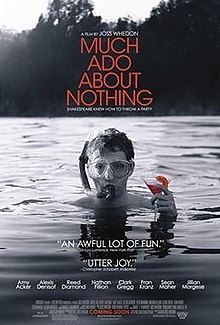
13th July 2013 - Joss Whedon's Much Ado About Nothing at E Street Cinema, DC

MuchAdo.jpgI was quite prepared to be a little sneery about Joss Whedon’s new film adaptation of this Shakespeare comedy. The early 1990s version, starring Kenneth Branagh and Emma Thompson, is my favourite film version of any Shakespeare play. And hearing that it was filmed in a few days in between Whedon’s more important projects, using lesser known actors from some of Whedon’s earlier TV work, implied that this wasn’t really a serious effort. And some of the earlier reviews seemed to be more excited about seeing the inside of Whedon’s home (used as the location) than about seeing a new Shakespeare adaptation (Much Ado about Whedon’s House…) But all of that is unfair on what is really a wonderfully joyous film.
Returning to the play, Beatrice is probably Shakespeare’s best female character – loyal to her friends, witty and strong. She is stranded in a man’s world that she can’t really change, and given the choice between bitter despondency and surrender (or both), she finds a third way combining cool detachment and humour (‘I had rather hear my dog bark at a crow, than a man say he loves me’). And when only a man can accomplish what she needs most (revenge for the ill-treatment of her cousin), she skilfully uses Benedick’s attraction to her to achieve it. Initially she has similarities with the pre-tamed Katherina from The Taming of the Shrew. But where Katherina is ultimately ‘tamed,’ Beatrice is never less than Benedict’s equal (and she often comes off better in their duels). She isn’t Shakespeare’s only strong woman; Portia in The Merchant of Venice is also a powerful, witty character. But Portia marries an idiot, whereas Beatrice and Benedick are matched perfectly. So their ultimate union is therefore much more satisfying. Benedict’s and Beatrice’s will they/won’t they love story might seem a little stale now, purely because it has been the basis of so many modern rom-coms, but there is so much else happening, and the characters are so much more profound than we would see in the average rom-com, that this play still has the power to move us.
So this is great material and that 1990s film adaptation is my idea of Shakespeare film perfection (except for one small drawback, which I’ll come back to). A cast of great actors; Emma Thompson was at her most alluring, Branagh was showing an early glimmer of the less annoying actor he would eventually turn into full-time, and Denzel Washington, Richard Briers, Kate Beckinsale and Brian Blessed added colour and character. The Tuscan setting is also every middle-class English person’s idea of Eden (I’m not middle-class, but I can still dream). Even the inclusion of Keanu Reeves at his most moronic barely detracted from the sheer loveliness of this film.
So Joss Whedon’s version has a lot to live up to. And early reports – filmed at Whedon’s house in only a few days, the lesser known cast - indicated that it might be an amateurish effort. But if it is amateurish, it is amateurish in the best sense in which the term was originally meant. In the Victorian period, the amateurs were the ones who did it for love and passion, whereas ‘professional’ was often a derogatory term, indicating one who put grubby money ahead of art. England’s cricket team was led by amateurs from their first test in 1877 until they appointed their first professional captain in 1952. Of course, such noble ideals didn’t always work out in reality, and the professional/amateur divide, when it is remembered today, is more often recalled as a time when talented working class professionals were demeaned in order to feed the egos of mediocre, entitled aristocrats. But in its noblest sense, in theory as opposed to employment, the cult of the amateur lauded love over money, and joy over seriousness. Which is all a long (long) way of saying that Whedon’s Ado is amateurish in the finest way possible. The acting is excellent, the Shakespearean language is really brought alive, and every twist and turn of that beautiful language is amplified and underscored, without ever being over-acted or dumbed-down. Shakespearian comedy, which, for me at least, is rarely actually very funny, here had the audience laughing throughout.
The use of actors with minor roles in Buffy and Angel was never a drawback because they all played their parts here with panache and aplomb, and their inclusion gave the audience a little bonus whenever they recognised an old favourite (‘Ah, it’s Drusilla the vampire, but with blonde hair’). Alexis Denisof as Benedick is much better without the irritating English accent he adopted in Angel, and Amy Acker (Beatrice here, Fred from Angel) is a revelation – beautiful, fragile, waspish and funny - she really needs to get some much bigger roles after this. The police were a big improvement even on the 1993 film. In Branagh and Thompson’s version, Dogberry was played by Michael Keaton in a manner more annoying than funny. Here, the police were incredibly dumb but still somehow believable, and very funny too. Finally, Whedon’s house is less impressive on the outside than I expected, but it’s very tastefully decorated inside, and the California style gave it a contemporary ‘nearly Italian’ feel that went well with the play’s setting.
This is a feel-good film that shows that ‘upbeat’ and ‘shallow’ don’t have to go together. It is also a celebration of old-fashioned love that leads to marriage. I left the cinema with a spring in my step, and my one regret at the end was that Whedon ‘wastes’ so much of his time making gigantic blockbusters like the Avengers, instead of focusing on his real vocation of making low budget Shakespeare adaptations.


Monday, 8 July 2013

Weeks Eight to Eleven, Top Seven Family Friendly Cultural Highlights in DC 2013

Ok, so nothing too highbrow during this period as my partner and our two daughters were visiting from England. When your priority is finding fun things for a 4 year old and a two year old to do, culture takes a back seat. So I haven't included excursions like the one to the Zoo but, even so, we managed to fit in a few things and here are the 'Top Seven Family Friendly Cultural Highlights in DC 2013' (in no particular order):


1) Breakfast at a Diner in Georgetown, bit of shopping, kids play in the big fountain, then a water-taxi from Georgetown to Alexandria and a visit to the Torpedo Factory Art Center.


2) Garden Fête at the French Embassy. Live bands, delicious pastries and the girls dancing away past their bedtimes...


Very hot day, so the in-door piano recital for a respite and relax was a bonus too.

3) Trip to the Kennedy Center for a free concert by Esther Biro and her Hungarian folk Klezmer band. One child fell asleep but everybody else enjoyed it, and you get good views of DC from the balcony.


4) Natural History Museum. Free entry, stacks of interactive stuff, educational and fun. It also helps if your kids have seen the Night at the Museum films.


5) Not actually in DC, but a pleasant train journey away: sightseeing in New York and an afternoon in Central Park.


6) Visit to the Library of Congress to enjoy the architecture, see where daddy works and play with the toys and books in the Children's Reading Room.


 7) Not, perhaps, that cultural: outdoor dinner at Clare and Don's Beach Shack whilst listening to the upbeat country sound of the 'DC Three.' Great food, though I suspect my deep fried Oreo and ice cream may have added a pounds...


Wednesday, 5 June 2013

Week Seven, Men Behaving Oddly Part One - The Winter's Tale

05th June, Shakespeare’s The Winter’s Tale, Lansburgh Theatre (ShakespeareTheatre Company)


Winter's Tale, The
I have never really seen The Winter’s Tale before, so I was looking forward to this. That ‘really’ was added because I have kind of seen it performed by children aged 3 to 7 at the Royal Shakespeare Company Theatre in Stratford. So I thought I had a rough idea of the plot (which turned out to be a very good idea of the plot – well done kids!), but now just wanted to see what some ‘proper’ grown up actors would make of it.

This production was at the Lansburgh Theater, which is the third venue I’ve visited for Shakespeare in DC and also the third most interesting. It’s smaller than the Harman, both in seating and the stage, but nowhere near as quirky as the Folger. In this production, the set is suggestive of a posh neo-classical country house drawing room, and the royal household of King Leontes are all dressed smartly, which gives it the feel of an episode of Agatha Christie’s Poirot. Being one of Agatha Christie’s biggest fans, this is an early point in the production’s favour. It’s also quite apt as Hermione is played by an actress (Hannah Yelland) whom the program informs me has appeared in Poirot. She did look familiar and so did Leontes (Mark Harelik) – I couldn’t decide whether I had seen him on television or if it was just because he reminded me of Rupert Everett, but it turns out he plays the boss of the physics department in The Big Bang Theory. So this is my first American Shakespeare with actors I have seen on the telly. They’re not exactly John Lithgow, but it’s something. The country house weekend mood is maintained with the drinking from decanters and the slightly tipsy behaviour.

This quite pleasant Edwardian/Wodehouse ambience is ominously interrupted by Leontes’ increasingly paranoid asides, and the dark effect is accentuated with strange, David Lynch-like noises (think the nightmarish bits from Mulholland Drive) and eerie pale blue lighting, which suggests more than a hint of some shadowy psychosis. This suggestion of mental imbalance is useful because from the dialogue alone we never really get a satisfactory explanation for Leontes’ sudden, groundless, and deadly suspicion. He seems to be comfortable in his world and his power is absolute. This is no Othello and there is no Iago to whisper poison in his ear. At the same time, the fear of unfaithfulness must be almost universal, and one could imagine it eating away at a mind that can get its way on every other issue but that. So this is a study in paranoia; even when a loyal and beloved servant attempts to use reason to defuse his suspicion, Leontes can only say ‘thou liest Camillo and I hate thee’.

In the first half this is a tale of misery, as has been suggested by Leontes’ son in the first scene, who says that ‘a sad tales’ best for winter’. So this play seems at first to be the inverse in all respects of A Midsummer Night’s Dream. But in that case we would expect the tragic elements to continue throughout, which isn’t so. The play is set up for tragedy but ends as comedy, making it a little disconcerting for the audience. The first half is tragic without, except for some words of Hermione’s, enough of the redeeming nobility of tragedy. But the second half is a farce. Rather than attempt to bring those parts together into a harmonious whole, for example by downplaying the most poisonous aspects of the first half and emphasising the dramatic and serious aspects of the second half, this production deepens and widens the chasm between the two worlds. In the first half, the horror of Leontes’ behaviour is played for all it is worth. The stage reflects the obsessive suspicion of his poisoned mind and the actor’s performance is physical enough to shock. Sitting in the second row was an incredibly uncomfortable experience at times as the entire atmosphere took on the suffocating closeness of a broken marriage under the shadow of domestic violence. The death of their son, the end of Leontes friendship with Polixenes, even the trial of Hermione, felt weightless in comparison with the pulsating rage and barely contained power of Leontes when he at one point flew across the stage to grab Hermione. Likewise, the second half contained added elements of physical farce and comedy, so the contrast between the two halves was dramatic, but not necessarily successful. Whilst the farce gave emotional relief, it did not really ‘make right’ or justify the action from the first half. The setting seems odd too, being set in Sicily with seaborne visits to landlocked Bohemia. The names are mostly Greek, rather than Sicilian or Bohemian (unless it is set in the ancient world when Sicily was Greek, but then that was before Bohemia existed). They swear by a mix of Roman and Greek gods: ‘By Jove’, ‘Apollo be my Judge’ and then they send to the Greek Delphic Oracle. So it is set in a hybrid world of ancient/modern, Greek/Roman.

This play has also sometimes been criticised for the meek portrayal of the female characters, especially Hermione. She doesn’t hesitate to forgive Leontes for his atrocious behaviour, which seems a little too easy on Leontes. But this is unfair. He has, after all, spent 16 years in miserable repentance. And if we follow the hints that Hermione has been alive the whole time in Paulina’s house, then it would seem that she could have revealed herself much earlier once she knew he was sorry. The fact that she waited so long suggests that she has already punished him, so there is no longer any need to cast a shadow over their reunion. There is also the issue that Shakespeare was writing in a man’s world. To say that women in such a world sometimes have to meekly accept injustice is not necessarily to endorse that world (and the goodness of Hermione, contrasted with the mad tyranny of Leontes could easily be read as criticism of male dominance). And the character of Paulina is the strongest in the play, much more forceful than her husband Antigonus, more just than King Leontes and, through her protection of Hermione, wiser than all of them. When Leontes asks Antigonus ‘canst thou not rule her?’, the answer for the audience is an emphatic and clear, ‘no he canst not’!

The program flagged up the apparently innovative (but also authentic) use of double roles for most of the actors, but I’m not sure we really gained much from it. On paper, pairing Leontes with Autolycus seems apt – Autolycus is the fool of Bohemia and Leontes has shown himself a kingly fool in Sicily. But mostly there was no real connection between the Sicilian and Bohemian pairings. And one of them was frankly odd without being interesting. The prince Murmillo and princess Perdita were played by the same actress, which had a superficial logic in that they were brother and sister, one born around the time the other died. And I have nothing at all against actors taking on different genders, which after all was done all the time by Shakespeare. But for a girl to play a boy the girl should at least look fairly boyish, which was really not the case here, with a Rubens-esque young lady playing the male child Murmillo. The actor portraying Florizel came across as weak and dainty, rather than dashing and princely, but fortunately he is not a key character.

The eccentricities of the plot have inspired me to develop my own, probably wrong and definitely un-provable, theory of its creation. The reasons for the kings jealousy are never explained, and we never really know for sure that Hermione is innocent, thought that is surely the conclusion we are pointed to. I believe that this play started out as an idea for a history play on Henry VIII – that towering figure of the Tudor period and renowned doubter of female fidelity. So Hermione is the adulteress Anne Boleyn, Perdita is Queen Elizabeth, and the emphasis towards the end on a King’s duty to remarry and beget an heir is both a reflection of Henry’s on-going quest to father princes and a reflection of the worry in Elizabethan England about what chaos and strife might follow upon the approaching death of the childless Elizabeth. But Shakespeare was much too sensible to put on such a play that might offend his monarch. Thus the names and locations are changed. Even so, to further reduce the dangers to Shakespeare’s life, the plot is then changed midway from tragedy to comedy, and becomes a fantasy about what would have happened if Anne Boleyn had been innocent and had not really died.

Anyway…
The Winter’s Tale is not one of Shakespeare’s best plays, and I would guess that it came early on in the period when Shakespeare was experimenting with tragi-comedies. But it is still an absorbing journey into strangeness, and an excellent, if frustratingly mysterious, study of the madness of jealousy.

Monday, 3 June 2013

Week Six, Part Two - The Robben Island Bible at the Folger Shakespeare Library

3rd June 2012 - The Robben Island Bible, Folger Shakespeare Library

The 'Robben Island Bible' refers to a book containing the complete works of Shakespeare that was one of the few non-religious books the inmates of Robben Island were allowed to keep during their incarceration for ‘political crimes’ against South Africa’s apartheid regime. The book was kept by Sonny Venkatratham, a prisoner on Robben Island from 1972 to 1978, and we heard how different Shakespearean stories and characters laid out the human condition and gave eloquent expression to the thought of the prisoners. This performance at the Folger was a staged reading containing extracts from the memoirs of the prisoners, particularly powerful extracts from Shakespeare and, less successfully towards the end, a contemporary and ideologically partisan critique of those prisoners who went from Marxists in the 1970s to capitalists in the 1990s. The problem with that criticism, apart from the obvious point that a communist post-apartheid economic policy would have made South Africa’s people poorer not richer, was the inability to make any allowance for the possibility that the prisoners may have changed their minds about the feasibility of communism based on reason (which seems especially likely bearing in mind the events of Eastern Europe and the USSR during that period): to the author of the play, the only possible reason for them to give up their communism was that they were corrupted by power and wanted to get rich once they took over. Apart from 
this unfair note of bitterness, much of the rest of the performance was fascinating.

Back in 1978, Venkatratham had decided that he wanted a souvenir of Robben Island upon his release, and so he passed around his The Complete Works of William Shakespeare to the other prisoners and asked each of them to write their name next to a section they found particularly meaningful. As we would expect, most of the readings came from tragedies rather than comedies, and the political plays like King Lear and Julius Caesar were well represented. A number of prisoners chose sections of Hamlet, which makes a great deal of sense: a central aspect of that play is the issue of whether to accept an injustice or to undertake a bloody and violent revenge. Hamlet eventually chose the bloody option, but to their eternal credit the Robben Island prisoners chose a more difficult path of forgiveness. Interestingly, the one extract from a comedy turned out to be Malvolio’s ‘some are born great, some achieve greatness, and some have greatness thrust upon them’. As I mentioned in my last post, that’s a popular modern sentiment, but in Malvolio’s mouth it was a sentiment to be mocked.

The really interesting thing for me was the number of extracts by anti-heroes or villains. Lady Macbeth’s inability to wash away the blood stain was likened to the moral stain of apartheid, but the really fascinating villain lines were those in which the prisoners identified with the villains. To express an affinity with Shylock’s complaints about Antonio’s racism was unsurprising, and in a similar vein one of the prisoners compared Caliban’s complaints about Prospero’s takeover of the island with the white regime’s domination and abuse of South Africa. But one prisoner chose lines spoken by Polonius, the character Hamlet accurately describes as a 'tedious old fool.' Another chose Macbeth’s lines about the meaninglessness of life (‘Life is but a walking shadow, a poor player that struts and frets his hour upon the stage and then is heard no more’). As a reminder of the regime's inhuman treatment of those prisoners, this quote more profoundly expressed the dehumanizing nature of their incarceration than the more direct descriptions of their ill-treatment.

Interspersed with the choices was the occasional snippet of information about the subsequent fate of the prisoners, such as Mobbs Ggirana. Mobbs' friends thought he had emigrated from South Africa upon his release. It was only much later discovered that the police intercepted him at the border, killed him, and buried him in an unmarked grave.

The choice we all really wanted to hear was, unsurprisingly, saved until last. Nelson Mandela’s choice was a fitting call to courage. Mandela chose Caesar’s lines from Julius Caesar:

Cowards die many times before their deaths                
The valiant never taste of death but once.’

Saturday, 1 June 2013

Week Six, Part One - Shakespeare's Twelfth Night at the Folger Shakespeare Library

1st June - Twelfth Night at the Folger Shakespeare Library

The venue of Washington’s other Shakespeare outlet has a much more authentic feel than the Sidney Harman Hall of the Shakespeare Theatre Company. Mock-Tudor exposed beams on white walls, Elizabethan-looking wooden pillars, interesting and delightfully antiquarian wooden seats and a dark, grungy atmosphere give it a real Renaissance feel. The low-level lighting is a little overdone on the balcony though, to the extent that the programme was impossible to read at my seat. Perhaps partly out of annoyance at this unnecessary inconvenience it got me thinking about what we really mean by authenticity: for me, and probably most of the audience, this dim and dismal auditorium seemed the height of authenticity but, of course, Shakespeare’s globe was roofless. At 2 pm on a sunny Saturday afternoon, Shakespeare’s audience would certainly not have been groping around in darkness at the Globe. Shakespeare’s company did eventually purchase an all-weather theatre when they were sufficiently successful, and the Folger could be a replica of that for all I know, but if so they really need to advertise the fact a little more prominently. I could be wrong, but I think dim-lighting is simply somebody’s idea of how a Shakespearean theatre should look. The Folger is much, much smaller than the Sidney Harman Hall, which again adds some inauthentic authenticity (the Globe could apparently hold upwards of 2,500 spectators). More importantly it also makes for a more intimate atmosphere, which the director has attenuated by having the cast occasionally exit the stage via the orchestra.

The setting of the play in 1915, with a Belle Époque atmosphere was a good choice (if original an inspired choice, but the play fits the period so well that I suspect it has been done a few times before). The story of shipwreck fits snuggly with the period of some of our most famous shipwrecks (the Titanic and the Lusitania). And the plot of disguise and love would suit any Wodehouse comedy equally well. Where I think this production was almost certainly original, and usually very successful, was the musical accompaniment. There was a piano on stage, providing an understated cinematic soundtrack throughout, but the periods of song were wonderful. ‘Daisy’ fitted the play perfectly.

The storm was beautifully done, though it was almost too elegant for a comedy. The balletic movement of the siblings, behind a translucent voile curtain would have been dramatic in a play with more emotional depth (e.g. The Tempest) but it hit a slightly discordant note in this lightest of comedies. Likewise, occasionally the piano accompaniment was over-gloomy. One of the most discordant scenes was so beautiful that I’ve accepted it anyway: at one point the Fool is singing to Orsino whilst Viola plays the cello. In some ways it was wasted in a comedy, but this was the most beautiful scene of the play.

One thing that happens here, which I thought perhaps reflected me but actually the audience reaction seemed to support my point – Shakespeare comedies are not, in themselves, especially funny. I’m quite ready to entertain the notion that they were hilarious when they were first produced and they remain excellent light romances, but there are very few pieces of dialogue that make one laugh. This was borne out by the audience reaction. There was plenty of laughter, but most of it came from aspects added by the cast and director – the facial expressions, the outfits, the slapstick, and the sub-verbal noises. Much of this might have been there in the original, but in the original I presume the dialogue raised a few more laughs too. It seems then that the challenge for a modern production of a Shakespeare comedy is to insert humour around the dialogue. This production does that well, but then it begs the question – why did I come to see a production of a Shakespeare comedy, if the funniest bits are those added by the moderns? Wouldn’t the same plot, but with a total rewrite by a gifted modern comic script-writer be superior? I would never dare to ask such a question of a Shakespearean tragedy, but comedy really doesn’t travel well – across time or space.

With that in mind the success or failure of a Shakespeare comedy is heavily reliant, perhaps over-reliant, on the quality of the actors. In this case, the Fool and Toby Belch were played perfectly, but Ague-cheek was simply mildly irritating. The biggest drawback was almost fatal though. Malvolio is the key role which holds the rest together. In the last version I saw, by the RSC in Stratford-upon-Avon, Malvolio was played by John Lithgow. Lithgow is one of my favourite comedic actors and he didn’t disappoint as Malvolio, but that has perhaps ruined me, because I shouldn’t expect others to reach those heights. And this Malvolio doesn’t, though he got plenty of laughs from the rest of the audience, so it might just be me being unfair.

Twelfth Night is a good reminder of the predictability of modern rom-com plots, in which the eventual lovers meet in the first five minutes, we all know they will end up together, and the entire film is a succession of obstacles we know they will overcome. Presumably such simplistic plots are what modern audiences want, but Twelfth Night does remind us that even light-hearted love stories can carry some depth and complexity.

On a final note, this was an interesting follow-up to Coriolanus, which in some ways supports the anti-democratic reading of that tragedy. Perhaps because Coriolanus had already put such thoughts in my mind, I couldn’t help thinking that the play’s unredeemed victim, Malvolio, was really being punished because he dared to dream above his station. I suspect that a modern comedy dealing with similar themes would have the poor man, not the Aristocratic men, get the girl. But Shakespeare’s audience, including its fair share of commoners, was apparently quite happy to see one of their own ridiculed, and for their social betters to achieve their happy endings. It’s interesting to note that Malvolio’s most famous lines (‘some are born great, some…’) are today usually used admiringly to describe how anybody can achieve great things in a democratic society. But for Malvolio it is a sign of his absurdity. Of course, Malvolio is more than just a social climber – he’s also one of those play-hating puritans.

Thursday, 30 May 2013

Week Five - What Maisie Knew, E Street Cinema

What Maisie Knew, E Street Cinema
What Maisie Knew Poster.jpgI wasn’t at all certain that I really wanted to watch this film. On the one hand, the description I had of it suggested a harrowing story about a sweet little girl suffering at the hands of her horrible, selfish parents. The pain of my own present separation from my kids makes viewing or thinking of anything even remotely comparable almost unbearable. On the other hand it was free. So I went along. The cast of adults were part of the appeal: Juliette Moore is usually great, the Viking vampire from True Blood (Alexander Skarsgård) has a real presence and I’ve liked Steve Coogan since his appearances on The Day Today in the early 1990s (though his serious roles have usually been less successful). The story follows the separation and subsequent activities of a New York couple and their thoughtful young daughter. It never really explains why the parents break up; though their later selfish and thoughtless behaviour towards Maisie suggests reasons (i.e. they are both exceptionally unlikeable). They do show glimmers of humanity and affection early on, before wrecking the appearance later, which also makes us suspicious whenever any other character does something decent.
It might be a good film to make divorcing couples watch as a cautionary tale (‘How not to act in Divorce’). I doubt whether it would make anybody reconsider the divorce itself, but as a powerful list of things that divorcing parents should not do (bad-mouth former spouse to the child, use the child to get back at the ex, let child find out about new boyfriend when he picks her up from school, disappear for long periods and leave child with new step-parents etc), it might at least encourage basic humanity. Perhaps one drawback of using the film like this might be that no divorcing parents would think they could ever be as bad and thus it might instil complacency. When the film starts the mother seems loving, but she quickly shows herself to be a horror. In this respect at least, there is some character development. The dad’s decency lasts a little longer, but still falls by the wayside. This makes is expect everybody to be similarly self-centred, but there were flickers of happiness and wholesomeness, just not from the people who should have been decent. Happiness isn’t elusive in the film and my pre-film fears of a relentless dirge of misery were eventually proven misplaced. But what does happen is that the happiness of day is always followed by the pain of night (usually literally). The step-parents are the most decent, affectionate people in it, but even with them we know that it probably won’t continue indefinitely. The young actress playing Maisie might be criticised a little for underplaying her role - she rarely shows outward signs of sadness - but this made the poor behaviour of her parents all the more affecting. We already knew the bad they were doing, and that it must be damaging Maisie’s soul, so the absence of histrionics simply added to the pathos.
In the fifth-century BC, an Athenian playwright called Phrynichus put on a tragedy showing the sack of Athens’ ally, Miletus. The Athenians were distressed, so on that level at least the play was a success. But the play was on a topic too close to the Athenians’ hearts and it turned out that the people were so distraught that they fined Phrynichus. It was decreed that tragedies should stick to mythological themes in future (which is the case for all of the tragedies that survived to the present). As a modern I should be aghast at this Athenian censoriousness, but actually they did have a point. What Maisie Knew is an effective and moving film, but it was also two of the worst cinematic hours of my life. In the end, although not as miserable as I anticipated, it is still not recommended viewing for anybody already feeling depressed and missing their children. Ultimately the film subverted the entire reason for my cultural calendar and the keeping of this blog - as a distraction from my homesickness.

Saturday, 18 May 2013

Week Four - Star Trek into Darkness & The Three Musketeers at the Synetic Theater

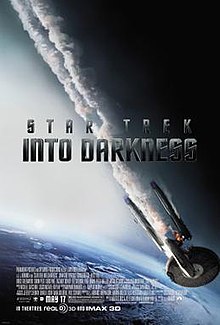
18th May - Star Trek: Into Darkness, AMC Theater, Courthouse Plaza, Arlington

The poster shows a flaming starship falling towards Earth, with smoke coming out. At the middle of the poster shows the title "Star Trek Into Darkness" in dark grey letters, while the production credits and the release date being at the bottom of the poster.I approached the 2011 film of the Hobbit with some trepidation. The book was such a beloved part of my childhood; perhaps more responsible than any other single book for pushing my tastes down the (geeky) path they have taken since. If Peter Jackson had replaced those wonderful memories with something superficial and twisted I would have been distraught. Luckily he didn’t. For some reason there had been no such fears about the 2009 ‘reboot’ of the Star Trek franchise, despite Star Trek, in repeats of the original series, in the film versions with Shatner et al and, perhaps most of all, in the Next Generation incarnation, being an equally well-loved and significant part of my childhood mental furniture. Part of the reason was that Star Trek has never really taken itself seriously (i.e. the Tribble episode of the original series). Partly this was also because there have already been so many frankly awful films made already (at least half of the films with Kirk in, all of the films with Picard in and every TV episode with Scott Bakula as captain). So one doesn’t approach a new Star Trek film expecting great things. Nonetheless the 2009 film confounded my pessimism – most of the actors were excellent replacements and the plot device of the disrupted timeline overcame the major drawbacks of setting a film in an earlier period (i.e. that we normally know what is going to happen). But this means, rarely for a Star Trek film, that Star Trek: Into Darkness begins with the disadvantage of bearing higher expectations. Luckily it fulfils them.

A couple of initial observations. Cumberbatch is best known for playing Sherlock Holmes and the character of Spock is based on Sherlock Holmes, so there was an extra soupçon of enjoyment for Conan Doyle fans in the Spock/Cumberbatch tussles. As an Englishman I almost feel obligated to decry the Hollywood ploy of having heroes talk with American accents and villains sound like posh Englishmen. But, really, deep down we all actually like it. If anybody was going to give Spock and Kirk a run for their money it’s good to know it was Englishman (though I couldn’t really have objected to a Latino choice in this case…) So Cumberbatch is a great villain – tough and fiendishly clever, he joins an elite company of English baddies who we secretly admire (Superman’s General Zod, The Lion King’s Scar, The X-Men’s Magneto, and Christopher Lee as Saruman, Count Dooku, and countless Count Draculas). As an Englishman it was also nice to see that the Union Jack still flies in London in the twenty-third century – I’ll stop worrying about the Scottish independence vote in 2014 now. And the moral qualms felt over Kirk’s mission to kill a terrorist without trial, using log-range photon torpedoes, looks particularly relevant in the week that Obama announced new limits on America’s use of drones to kill terrorists.

My opinions on casting haven’t altered from the 2009 film – Spock, Uhura, Chekhov, and Sulu were and remain fantastic choices. Kirk and Scottie – not so much. I like Simon Pegg in other things, but his Scottish accent is diabolical, his body shape and face are all wrong, and the slapstick comedy attached to his character never hits the right note. Kirk is ok, but not great. I’m doubtful whether anybody else could have really convinced as Kirk, though the news this week that scientists have now successfully cloned human embryos does make one wonder if the reboot should have been put on hold until we could have cloned and raised a new Shatner.

Finally, the plot was predictable in places – it was fairly clear who Cumberbatch was long before it was revealed, and an important plot device from the final segment was also too obvious. Nonetheless, it was a fun film and it definitely found the right mix between adding enough novelty to surprise and amuse us, whilst at the same time keeping enough of the old Star Trek to pull at our nostalgia strings. A welcome addition to the franchise.


18th May - The Three Musketeers at the Synetic Theater, Crystal City


My program informs me that the Synetic Theater’s name derives from its ‘synthesis’ of different art forms and its emphasis on ‘kinetic’, dynamic movement. For a Hellenophile like me, using Greek words gets it off to a good start before I even sit down. The program also describes the Synetic Theater as Washington DCs ‘premier physical theatre,’ though I was less sure of what that would mean in practice (do we have ‘physical theaters’ in England? My cultural education continues…) The theatre is approached from the metro station by the tunnels of Crystal City, which doesn’t make it a particularly scenic walk on a quiet evening - it brought back memories of the chap being chased and eaten on the London Underground in American Werewolf in London. It’s a small venue (‘intimate’ in estate agent and theatre program-speak) and the stage is not what I expected would be the case to produce ‘physical theater’. The music before and during the play is mostly classical, which doesn’t match the avant-garde expectations built up by the program description, but does evoke the atmosphere we expect of seventeenth-century Paris.

The story needs no explanation – there have been plenty of film versions, and for anybody my age the Dogtanian series of the 1980s is still the zenith of musketeer (muskahound?) adaptations, though the Michael York/Oliver Reed versions of the 1970s run it close. Like Star Trek, the humour of the other versions and occasionally awful remakes (i.e. the 2011 film with the flying galleons) mean that you approach any version of Musketeers with realistic expectations – it’s not going to incite any profound insights into the human condition, but as long as it doesn’t take itself seriously and has some good fight scenes you’ll exit satisfied.

This stage version maintained a number of strong points from previous versions, and especially the earthier humour of the 1970s films. Occasionally the comedy didn’t quite come off, and I couldn’t work out whether Porthos was supposed to be a grunting simpleton or a deaf man with simple tastes (he is deaf), but mostly it worked well. The fight scenes were strange though – much more realistic than equivalent scenes from a ballet/dance, but still too stylised to be realistic. The result was dissatisfaction on both counts. The weakest aspect was the dialogue, which was uniformly two-dimensional and stilted. And the acting was mixed. Athos was adequate, Richelieu was good, and the outright comedy roles were excellent (Louis XIII and Aramis especially). None of the female characters ever rose better than average. Milady was at her best whenever she wasn’t speaking – she had two assets for the role but neither of them was her acting ability. In fairness, Milady’s acting was not the worst on show, and as the understudy we might expect that she is not yet the finished article. The actor playing D’Artagnan reminded me most of a successful Hollywood actor. Unfortunately, the actor he reminded me of is Keanu Reeves. And even more unfortunately, it was the Keanu Reeves of Bill and Ted’s Excellent Adventure, not the Keanu Reeves of The Matrix. The combination of naïve idealism, bloodthirsty toughness and comedy is difficult to pull off, but this D’Artagnan never really came close. The best scenes were those which showcased the synthesis and kinesis of the theater’s name. The erotic tango between Milady and Richelieu, in the middle of a chaotic, violent melee, was sublime. Likewise, D’Artagnan’s meeting with the musketeers in a busy crowd was a brilliantly choreographed hybrid of ballet, acrobatics and slapstick. 


The production reached its peaks of fun during the musketeer fighting scenes, but the story’s tragic elements were much less convincing. In summary, the synthesis is not quite balanced yet. A really good writer and some acting lessons would be a good investment before the Synetic produces its next ‘talkie’. But the choreography of movement was fantastic, and I keenly await their silent production of A Midsummer Night’s Dream later in the summer. 

Friday, 17 May 2013

Week Three, Part One – Coriolanus from the Shakespeare Theatre Company

Coriolanus, by William Shakespeare at the Shakespeare Theatre Company’s Sidney Harman Hall

Allan Bloom and Harry Jaffa, disciples of the political philosopher Leo Strauss, once wrote a book called Shakespeare’s Politics. I haven’t read it yet, though it is on my summer reading list, but I would guess that they covered Coriolanus quite thoroughly. It is one of Shakespeare’s most political plays, and seems to point to a number of themes covered by Straussians elsewhere. This is not about one, albeit complex, individual scheming his way to power, like Macbeth or Richard III, but about a collision between two political worlds: democracy and aristocracy. Democracy has triumphed in the modern West, so we are inclined to take its superiority for granted. And that would certainly be one way to interpret Coriolanus. The first thing said by one of my companions was that Coriolanus is a story about the tragic inflexibility of a great, aristocratic man. His undoing is that he is so noble that he can’t bring himself to flatter, or even show basic politeness, to those of lower status. He regards the people as a mob. Which is certainly true as far is it goes. Coriolanus values his honour over his life and has nothing but contempt for the poor who only seem to want cheap food. And we could say that it is easy for an aristocrat to scorn those who think first of their bellies, but not so easy for those who live daily with poverty.
But in turning away from the aristocratic arrogance that is exemplified by Coriolanus, does democracy also turn its back on the possibility of nobility? Shouldn’t there really be more to life than the search better material conditions? The democrats might argue that, yes, the search for life’s higher meaning can take place once our basic material wants are satisfied, and that such meaning should not belong to the rich alone. This is the drift of liberal thought since the enlightenment. But that is not quite the way Shakespeare portrays it. The common people in Coriolanus don’t really deserve respect: they are a fickle and easily led rabble. They are manipulated by the two democratic tribunes into attacking Coriolanus and banishing him from Rome. And when Rome is then under attack, they blame the hapless tribunes for leading them astray. These tribunes are classic demagogues, out to further their own careers by rousing the people against the rich. Shakespeare, like the anonymous ‘Old Oligarch’ of ancient Athens, seems to think that ‘the highest scrupulousness in the pursuit of excellence is to be found in the ranks of the better class, while within the ranks of the people will be found the greatest amount of ignorance, disorderliness, rascality - poverty acting as a stronger incentive to base conduct, not to speak of lack of education and ignorance, traceable to the lack of means which afflicts the average of mankind.’ Of course, Shakespeare was living and writing in a monarchy, so he was not going to get into trouble for criticising rule by aristocratic or democratic regimes. To that extent, the play authenticated the political system of his day. But it would be interesting to know how the audience responded to his portrayals? The theatre of his time was wonderfully mixed, from the highest to the lowest. Did they identify themselves or their contemporaries in Coriolanus, or did the setting of events in antiquity make the issues less significant to all except the most thoughtful?
It is interesting that the Old Oligarch blames much of the poor’s rascality on their lack of education (which itself results from their poverty). Even this forthright oligarch seems to be saying that democracy might therefore work well if everybody could be educated. Modern technology and material wealth has now led to just that situation, which might be said to have negated the Old Oligarch’s criticisms of the poor, though this is dubious, but the real modern relevance of the play is the two tribunes. These men are clearly better educated than the rabble they lead, but they seemed to have turned against their own class to further their ambitions. They also have no respect or gratitude for the soldiers, like Coriolanus, who protect them. In other words, they are modern left-wing intellectuals who, in the words of Kipling, ‘make mock of uniforms that guard you while you sleep’. And what universal education has mostly done in that respect is send lots more people to university – creating a bigger, shallower intelligentsia. As an aside, for anybody who does feel any sort of gratitude to the soldiers who risk and sometimes lose their lives to defend civilisation, America is a refreshing change to Europe. It must still have its share of one-eyed ‘pacifists’ as well, and on the other side the incessant ‘USA! USA! USA!’ of any sporting event can be trying, but there is a genuinely affectionate, unselfconscious, simple patriotism here which warms the heart.
Coriolanus, like a couple of Shakespeare’s other tragedies, is based on one of Plutarch’s Lives. These were short and very engaging biographies of famous Greek and Roman figures written by the Greek Plutarch during the Roman Empire. Unlike the modern Penguin editions, which tend to group the biographies together by subject (a book of Spartan biographies, a book of Roman biographies and so on), Plutarch originally organised his biographies into pairs, each one containing a Greek and Roman whose lives had something in common (for example the successful military leaders Julius Caesar and Alexander the Great). One of my companions at the play, who happens to be a Plutarch expert, told me the surprising news that Plutarch paired Coriolanus with Alcibiades. This has some superficial logic, because both enjoyed early success but then joined with the enemies of their homelands in war against their own people. But besides that the two were very different characters. Coriolanus can’t succeed as a politician because he is too rigid, too principled to make the necessary compromises.  His attack with the Volscians on Rome is motivated by the assault on his honour committed by the tribune-inspired masses. Eventually bowing to the pleading of his mother to spare Rome, he takes his army away to face death at Volscian hands. Alcibiades was a cad all along. A complex, attractive, charismatic cad, but by all accounts somebody with no real moral fibre. He encouraged Athens’ into wars for his own personal gain, and then when ordered to return to Athens to stand trial for impiety, he went over to Athens’ great enemy, Sparta. Then he helped the Spartans to wreck Athens’ Sicilian Expedition, which had been his idea in the first place. Eventually the Spartans grew tired of him (possibly because he slept with the wife of one of their kings) and he returned to the Athenians, who welcomed him back until at a later date he was banished again for leaving the charge of the Athenian fleet in the hands of his incompetent lieutenant (who then lost the fleet). Alcibiades was an aristocrat like Coriolanus, but like the tribunes he was an able manipulator of the mob to further his own ends. I really must revisit Plutarch to read his reasons for this pairing. But back to the play…
This production is sublime – better in all ways than the 2011 film version starring Ralph Fiennes. The costumes were interesting; using modern costumes can sometimes backfire, especially if done to stress some overstretched point of relevance to the present day, but in this case they worked to support rather than subvert the central themes of the play. Some of the women in Plutarch seem especially alien to modern audiences. Like the women portrayed in Plutarch’s accounts of Sparta, Coriolanus’ mother Volumnia was bloodthirsty and seemingly uncaring about whether her son lived or died, so long as he did it with honour and maintained the standing of the family name. She was played with the perfect amount of stridency and aristocratic hauteur by Diane D’Aquila. Again, this is another side of the aristocratic ethos which we have lost (probably for the better) in our more democratic age. Another interesting innovation was the drumming - along with the excellent stage, it helped to create the evolving atmosphere that heightened the significance of the dialogue and action, especially during the fight scenes. Stage battles, where a handful of men are used to represent entire armies, are often flat and amateurish. Perhaps they appear more insipid because our imaginations are dulled by the ultra-realism of film violence. But the drumming here amplified the life and power of the violence to add a real air of menace, fear and desperation. Patrick Page, as Coriolanus, was much more realistic and appropriate to the story than Fiennes’s psychotic film portrayal. He really succeeded as the hardened aristocrat. One of my companions picked up on the aspect of playfulness in having an arch pretender (an actor), pretending to be someone whose greatest fault is that they can’t pretend. Page really carried this aspect off and his mannerisms at the point where his character was pretending to attempt to pretend was his most human scene of the play. Shakespeare loved this sort of contradiction, as with the comedy situations of men playing women pretending to be men, and the actor did it excellently here with some bitter frivolity of tone and action suitable to tragedy.
Finally, I said when talking about Wallenstein last week that I found the American accents jarring. That was not the case with Coriolanus – if anything, perhaps Americans make better, more believable Romans than English actors do (Rome certainly never seems very far away in a city as stuffed with neo-classical architecture as Washington DC). The problem, I think, with Wallenstein, was that the translation was very modern, creating a constant jarring between the content of what was said and the way it was said. The accents fitted the translation but the translation did not fit the play.