One of the most interesting aspects of the film is its bleak depiction
of post-war London. Attention focuses on the working class squalor of bombed
out London, which gels perfectly if starkly with the film’s darker themes;
however, the scenes in London pubs, each one a rowdy, drinking choir, reminds
us of what was lost when jukeboxes and televisions became pub fixtures. Much
maligned karaoke nights may be a snugger fit within the British social
landscape than we usually imagine. Hester’s naive ecstasy when trying to join
the singing without knowing the words is exceptionally moving.
A diary of cultural experiences and reviews, including plays, books, films and more
Showing posts with label love. Show all posts
Wednesday, 15 April 2015
Mini Film Review: The Deep Blue Sea
Labels:
film,
love,
plays,
reviews,
Terence Rattigan
Location:
England, UK
Tuesday, 3 March 2015
The Shoemaker's Holiday Review
Review: The Shoemaker’s Holiday, Thomas Dekker, Royal Shakespeare Theatre,
Stratford upon Avon. 14 February 2015
Shakespeare’s contemporaries get a raw deal in the game of glory but,
although they were all dealt a poor hand, some still managed to win bigger
shares of the pot than others. Partly for the seedy and mysterious glamour of
his life and death, Christopher Marlowe lives on in our collective imagination;
and Ben Johnson also managed to find a little space in our hearts. But we’d
have to work our way a long way down the list before we got to Thomas Dekker.
This is in some ways unfair. Like Shakespeare, he was competent in different
genres, including a successful side-line as a pamphleteer, and he was perhaps
ahead of Shakespeare in seeing the future of comedy. Modern rom-coms like Love, Actually are closer to Dekker’s city
comedies, set in London and featuring ordinary folk, than Shakespeare’s tales
of Italian aristocrats. And whereas the little we know about Shakespeare’s
private life suggests it was a fairly ordinary (some might say boring) journey
towards comfortable respectability, Dekker’s life included such fascinating if
unfortunate titbits as a seven year stretch in the slammer. Even so, there is
no dishonour in being outshone by Shakespeare. The real indignity has been
inflicted by Google: search for Thomas Dekker and you’ll find our playwright
appearing below his modern namesake, an actor renowned for appearing in TV
versions of The Terminator and Honey, I Shrunk the Kids.
So, it’s nice of the RSC to put on a Dekker at the Swan Theatre. The Shoemaker’s Holiday consists of two
intertwined love stories. One story revolves around the aristocratic Rowland
Lacy and the rich but un-aristocratic Rose Oatley, both of whom are despised by
the others’ families. Rowland is tasked with rounding up men to send as
soldiers to fight in France under Henry V (the play was put on shortly after
Shakespeare’s Henry V and is in some ways a comedic response) and he rounds up married
shoemaker Rafe, who is sent to France, from whence he eventually returns a
cripple to find out that his wife thinks he is dead and is about to marry
somebody else. Rowland deserts the army and stays in London disguised as a
shoemaker, taking Rafe’s job so that he can continue to woo Rose. SPOILER
ALERT: the two couples wind up together at the end.
The play begins to go wrong almost immediately by including a needless
introduction which gives much of the plot away before the play begins. The
introduction does say that ‘Nothing is purposed here but mirth’, which is at
odds with the anti-war theme picked up by some critics and focused upon in the
RSC programme. But were Elizabethans anti-war in a recognizably modern way? Or
were they more fatalistic – war was a tragic but inevitable part of life, to be
avoided if possible, to be accepted if necessary.
The humour is juvenile: fart jokes, names like Cicely Bumtrinket, much pissing,
talk of bums, a character named Firkin, around whom there are numerous uses of ‘Firk
you’ and ‘Firked’, a couple of ‘prick’ puns, and everything is excessively, needlessly,
tediously spelled out. Where the humour does initially work well, it is often
repeated until it becomes stale. The phrase, ‘Prince am I none, yet am I nobly
born, as being the sole son of a shoemaker’ is said at least four times. To
‘Dance the shaking of the sheets’ is a good description of sex, but repeating
it smacks of desperation. Likewise, the play overall dragged on much too long,
with seemingly irrelevant issues cropping up at the end such as a new hall where
the shoemakers could trade leather two days a week: presumably this was once
topical, and perhaps interesting, now it is neither. Despite the
over-simplicity of the story, the needless repetition and the reliance
throughout on the lowest common denominator, the play is paradoxically more
difficult to understand than anything by the much more complex Shakespeare. The
reason is Dekker’s over-reliance on jargon, whereas Shakespeare had the gift of
being able to use simple language in clever ways.
![]() |
| David Troughton as Simon Eyre |
Perhaps the biggest weakness, for what is, after all, a love story, was
that the two pairs of lovers are both incredibly dull. The actress playing Rose
Oatley, Thomasin Rand, gave a game performance, but neither she nor the others
had much to work with. The most interesting character is Simon Eyre, whose
language is odd but not especially clever: much of it relies on the incongruity
of calling London bums ‘Brave Hyperboreans’, ‘Mad Mesopotamians’, ‘Babylonian Knaves’,
‘True Trojans’ and so on. The programme describes Eyre as Falstaffian and there
is something in this, which fits in nicely with the Agincourt link: Shakespeare
had killed off Falstaff so by introducing his new Falstaff and having him
befriend King Henry V , Dekker was perhaps trying to tap into Falstaff’s, and
Shakespeare’s, popularity. Even so, the programme goes a little too far in
suggesting that Eyre shares Falstaff’s moral qualities. Eyre is a much more
upright, though less interesting, character; extremely loyal to his workers and
the soul of generosity. David Troughton, playing Eyre, was excellent but again let
down by some mediocre dialogue: I suspect he would make a fantastic Falstaff. It
was a very nice idea of the director’s to have the clothes of Eyre and his wife
change as their social standing improved during the play. They begin the play
in rags but by the end of the play she is Queen Elizabeth I and he is Henry
VIII.
From a social perspective, there is more here for the common man than we
would get in the average Shakespeare play: cross class love affairs, the victories
of the apprentices over the gentlemen, the rise of Simon Eyre to Lord Mayor, and
the sympathetic portrayal of an entire profession (the ‘gentle craft’ of
shoemakers). Even Henry V turns out to be an egalitarian at the end: ‘Does thou
not know that love respects no blood?’
Historicist readings of Shakespeare attempt to explain his plays based on
the historical context, explaining why and how he covers certain themes because
of the society he lived in. This can be an enlightening approach, but it can
also blind us to what is unique about Shakespeare: his genius. Watching a play
like this reminds us of a simple truth: Shakespeare is better remembered than
his contemporaries because his plays are better than theirs. But if Shakespeare
was the towering genius that the old ‘Great Men’ historians might have
portrayed, could he have been so great as to transcend his historical context?
If we moderns can discover ‘history’ then we are exempting ourselves from its
grip (by knowing ideas are historically determined, then can’t we disregard the
ideas we recognize as determined by our own historical context?) But in
discarding such ideas, does that leave us with nothing, nihilism, or does it
free us to recognize eternal ideas? And if we can put aside our historically
determined ideas (a big if) isn’t it possible that other people (like
Shakespeare) might have done so in the past? Perhaps the ability to transcend
his historical conditioning was one of the factors that made Shakespeare such a
great playwright (ok, this is getting a little circular). The Socrates of
Plato’s Republic argued that society
is a cave of opinion, from which only a few philosophers find their way out
into the sunlight of real truth. Many of today’s intellectuals accept that
society is a cave of opinion, but think there is nothing at all outside the
cave. All supposed truths are mere opinions. On this evidence, Dekker is firmly
ensconced inside the cave. Take away the play’s topicality and there isn’t much
left. The Shoemaker’s Holiday is an
interesting picture of the Elizabethan cave, but it doesn’t point the way to
any deeper idea of what it is to be human. A number of Straussians have examined
Shakespeare’s plays for the eternal problems, believing that Shakespeare was
able to see that sunlight of real truth. Maybe there’s something in it.
Labels:
comedy,
culture,
Dekker,
love,
Midlands,
plays,
RSC,
Shakespeare,
Shoemaker's Holiday
Location:
Stratford-upon-Avon, Warwickshire, UK
Saturday, 24 August 2013
Week Eighteen, Much Ado About Nothing Redux
24th August 2013, Much Ado About Nothing by the Shakespeare Theatre Company
This will be a short and sweet final instalment of my DC Culture Diary. During my busy final few days, I don't have time for an in-depth review, and this particular play, although not this production, has already been dissected on this blog here. This is probably my favourite Shakespeare play (according to the mother of my theatre companion, it's everybody's favourite Shakespeare play), and all that really needs to be said about this production was that I wasn't disappointed. The Cuban setting made for a raunchy, salsa-filled and passionate production, which managed to seem both novel and traditional at the same time (Sicily being a Spanish-owned island as well, when the original play was set). The comedy was as funny as in Whedon's film, but more impressive for being live, and the biting banter between Benedick and Beatrice both charming and edgy. Recognising an actor from television (Tony Plana, from Ugly Betty) was also a nice bonus. All in all, a great performance, and all the better for being free - after four entries to the Free for All ticket lottery I was just beginning to think I might have to join the queue outside, but my persistence finally paid off.
Now, it's back to England - my next appointment with the Bard will be in his home town for a performance of Antony and Cleopatra by the RSC.
This will be a short and sweet final instalment of my DC Culture Diary. During my busy final few days, I don't have time for an in-depth review, and this particular play, although not this production, has already been dissected on this blog here. This is probably my favourite Shakespeare play (according to the mother of my theatre companion, it's everybody's favourite Shakespeare play), and all that really needs to be said about this production was that I wasn't disappointed. The Cuban setting made for a raunchy, salsa-filled and passionate production, which managed to seem both novel and traditional at the same time (Sicily being a Spanish-owned island as well, when the original play was set). The comedy was as funny as in Whedon's film, but more impressive for being live, and the biting banter between Benedick and Beatrice both charming and edgy. Recognising an actor from television (Tony Plana, from Ugly Betty) was also a nice bonus. All in all, a great performance, and all the better for being free - after four entries to the Free for All ticket lottery I was just beginning to think I might have to join the queue outside, but my persistence finally paid off.
Now, it's back to England - my next appointment with the Bard will be in his home town for a performance of Antony and Cleopatra by the RSC.
Location:
Washington, D.C., DC, USA
Thursday, 1 August 2013
Week Fifteen, A Midsummer Night's Dream
1st August 2013, A Midsummer Night’s Dream at the Synetic Theater
The performance opened in darkness, with unseen dancers
moving, seemingly haphazardly, across the stage holding small lights. It was as
though a swarm of fireflies were floating frenetically in the night. But as the
stage grew lighter, the music took on a tenor suggestive of eastern mysticism,
the performers moving like Indian temple dancers and the lights now obviously
mini electric candles, evocative of Diwali, the Festival of Lights. Finally,
two more dancers emerged, more gloriously arrayed than the others, Titania and
Oberon. But Titania as Hindu Goddess. There then follows a bizarre prologue to
the play in which we see Puck being born (fully grown) years earlier from a
mother who then dies, leaving him to be reared by the faerie monarchs.
Outlandish and captivating so far.
Then the story cut to the more prosaic present, in Athens, where
Hermia is due to be married by Duke Theseus to Lysander. But Hermia really
wants to marry Demetrius and Hermia’s friend Helena wants to marry Lysander
(but he’s seemingly in love with Hermia). So there follows the standard
Shakespearean story of the youngsters fleeing into the woods where they are the
focus of Puck’s mischievous magic, and all is chaos until the denouement when
everybody loves the person they are supposed to love and Theseus agrees to let
them all be married. Along the way we have the domestic tiff between Oberon and
Titania and the incredibly dull sections with Bottom and his fellow actors. All
told without words.
The Synetic is a small theatre and for this show I’d bagged
an especially good central second row seat from which to appreciate the
physicality of cutting edge dance. I was not disappointed. There are some
fantastic uses of movement to create illusion, such as the early section with
Demetrius running on the spot and somebody running past him breaking paper
doors over him to create the illusion that Demetrius is running through a
building and barging through doors (you probably had to be there). Titania and
Oberon’s battle over Puck, with the three actors suggesting magical forces at
play purely from their own movements, was delightful and stunning. The crowded
movement scenes, as in The Three
Musketeers, were the most engaging, and another excellent scene was that
when the enchanted Demetrius and Lysander were fighting over Helena and
fighting off Hermia. There was lots of playfully raunchy humour in that scene
too (more Benny Hill than anything actually erotic), which was charming in its
knowing innocence. But Puck (Alex Mills), even when alone on the stage, was the real star of
the show throughout. Whether climbing up a rope, jumping onto the moon, doing
back-flips, contorting himself like a yogi or walking around on his hands,
every leap and twist was so natural and, seemingly, effortlessly that one could
not help but be impressed. The scene where is was seemingly being pulled all
over the stage by a small flower in his hand sounds pretty feeble in
description, but actually both funny and beautiful. Really.
Of course, Shakespeare is rightly loved for the power of his
words, so you can’t take all the words out and expect every single thing to be
hunky dory. For one thing, the performers’ actions have to be extremely obvious
to make sure everybody sees them, especially when there are multiple actors on
the stage. The jokes were often particularly banal (fart noises, really?), such
as depicting Helena’s unrequited longing by having her swig dramatically from
an oversized bottle whisky and Hermia overacting when appearing drunk at her
engagement party. Shakespeare was at fault for the most tedious, cringe-worthy
sections, which were the scenes involving Bottom and the play within a play.
These sections are the key reason, for me, that the play doesn’t keep me
gripped whoever is performing it. Dull with dialogue, dull without.
Nonetheless, there were a number of laugh out loud moments, especially relating
to Helena’s attempted wooing of Lysander. The actress playing Helena (Emily
Whitworth) has a real gift for comedy.
One of the strongest aspects of the performance was the
original score by Constantine Lortkipanidze, who really ought to be scoring
major films. The music always added to, and never distracted from, the action.
He also had a small part in the cast as the pianist accompanying Bottom’s play,
where his musical accompaniment was the highlight (indeed, the only light) of
those otherwise dull sections.
Overall, it wasn’t always as funny as I might have liked,
but I was still swept along by sheer admiration for the acrobatic feats of
dance and movement. For me, this made a bad Shakespeare play watchable. I would
love to see a Synetic version of a Shakespeare play that I actually like, but
unfortunately I’ll be leaving before the new season begins. The Synetic gives
me one more reason to return to DC in the future.
Labels:
Arlington,
comedy,
culture,
education,
love,
music,
plays,
reviews,
Shakespeare,
Synetic Theater,
theatre,
Washington
Location:
Washington, DC, USA
Saturday, 13 July 2013
Week Twelve, Much Ado About Nothing
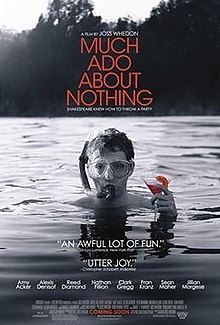
13th July 2013 - Joss Whedon's Much Ado About Nothing at E Street Cinema, DC
I was quite prepared to be a little sneery about Joss Whedon’s new film adaptation of this Shakespeare comedy. The early 1990s version, starring Kenneth Branagh and Emma Thompson, is my favourite film version of any Shakespeare play. And hearing that it was filmed in a few days in between Whedon’s more important projects, using lesser known actors from some of Whedon’s earlier TV work, implied that this wasn’t really a serious effort. And some of the earlier reviews seemed to be more excited about seeing the inside of Whedon’s home (used as the location) than about seeing a new Shakespeare adaptation (Much Ado about Whedon’s House…) But all of that is unfair on what is really a wonderfully joyous film.
The use of actors with minor roles in Buffy and Angel was never a drawback because they all played their parts here with panache and aplomb, and their inclusion gave the audience a little bonus whenever they recognised an old favourite (‘Ah, it’s Drusilla the vampire, but with blonde hair’). Alexis Denisof as Benedick is much better without the irritating English accent he adopted in Angel, and Amy Acker (Beatrice here, Fred from Angel) is a revelation – beautiful, fragile, waspish and funny - she really needs to get some much bigger roles after this. The police were a big improvement even on the 1993 film. In Branagh and Thompson’s version, Dogberry was played by Michael Keaton in a manner more annoying than funny. Here, the police were incredibly dumb but still somehow believable, and very funny too. Finally, Whedon’s house is less impressive on the outside than I expected, but it’s very tastefully decorated inside, and the California style gave it a contemporary ‘nearly Italian’ feel that went well with the play’s setting.
Returning to the play, Beatrice is probably Shakespeare’s best female character – loyal to her friends, witty and strong. She is stranded in a man’s world that she can’t really change, and given the choice between bitter despondency and surrender (or both), she finds a third way combining cool detachment and humour (‘I had rather hear my dog bark at a crow, than a man say he loves me’). And when only a man can accomplish what she needs most (revenge for the ill-treatment of her cousin), she skilfully uses Benedick’s attraction to her to achieve it. Initially she has similarities with the pre-tamed Katherina from The Taming of the Shrew. But where Katherina is ultimately ‘tamed,’ Beatrice is never less than Benedict’s equal (and she often comes off better in their duels). She isn’t Shakespeare’s only strong woman; Portia in The Merchant of Venice is also a powerful, witty character. But Portia marries an idiot, whereas Beatrice and Benedick are matched perfectly. So their ultimate union is therefore much more satisfying. Benedict’s and Beatrice’s will they/won’t they love story might seem a little stale now, purely because it has been the basis of so many modern rom-coms, but there is so much else happening, and the characters are so much more profound than we would see in the average rom-com, that this play still has the power to move us.
So this is great material and that 1990s film adaptation is my idea of Shakespeare film perfection (except for one small drawback, which I’ll come back to). A cast of great actors; Emma Thompson was at her most alluring, Branagh was showing an early glimmer of the less annoying actor he would eventually turn into full-time, and Denzel Washington, Richard Briers, Kate Beckinsale and Brian Blessed added colour and character. The Tuscan setting is also every middle-class English person’s idea of Eden (I’m not middle-class, but I can still dream). Even the inclusion of Keanu Reeves at his most moronic barely detracted from the sheer loveliness of this film.
So Joss Whedon’s version has a lot to live up to. And early reports – filmed at Whedon’s house in only a few days, the lesser known cast - indicated that it might be an amateurish effort. But if it is amateurish, it is amateurish in the best sense in which the term was originally meant. In the Victorian period, the amateurs were the ones who did it for love and passion, whereas ‘professional’ was often a derogatory term, indicating one who put grubby money ahead of art. England ’s cricket team was led by amateurs from their first test in 1877 until they appointed their first professional captain in 1952. Of course, such noble ideals didn’t always work out in reality, and the professional/amateur divide, when it is remembered today, is more often recalled as a time when talented working class professionals were demeaned in order to feed the egos of mediocre, entitled aristocrats. But in its noblest sense, in theory as opposed to employment, the cult of the amateur lauded love over money, and joy over seriousness. Which is all a long (long) way of saying that Whedon’s Ado is amateurish in the finest way possible. The acting is excellent, the Shakespearean language is really brought alive, and every twist and turn of that beautiful language is amplified and underscored, without ever being over-acted or dumbed-down. Shakespearian comedy, which, for me at least, is rarely actually very funny, here had the audience laughing throughout.
This is a feel-good film that shows that ‘upbeat’ and ‘shallow’ don’t have to go together. It is also a celebration of old-fashioned love that leads to marriage. I left the cinema with a spring in my step, and my one regret at the end was that Whedon ‘wastes’ so much of his time making gigantic blockbusters like the Avengers, instead of focusing on his real vocation of making low budget Shakespeare adaptations.
Labels:
cinema,
comedy,
culture,
education,
love,
plays,
reviews,
Shakespeare,
Washington
Location:
Washington, DC, USA
Sunday, 9 June 2013
Week Seven, Men Behaving Oddly Part Two - The Guardsman
9th June 2013,Ferenc Molnar’s The Guardsman at the Kennedy Center
After seeing a number of Shakespeare productions set in
different periods, it was at least refreshing to see that a play written in the
Budapest of the early 1900s was actually set in the Budapest of the early 1900s.
And the stage design was excellent. Most of the play takes place in an upper
middle class drawing room, with the remainder set in a box at the opera, and
both locations were gorgeously represented. In the
drawing room, La Belle Époque art hung on scarlet walls, the
actress played Chopin on the grand piano, and the stage was liberally adorned
with elegant Parker Knoll type armchairs, lavish floor cushions and chaise
longues. The whole thing effortlessly called forth that central European
bourgeois, Bohemian world which was eventually flattened to make way for the
great, grey, grim utopia of communist dreams.
The
program also made promising reading. The original Guardsman was written by Molnar Ferenc as a dark and bitter black
comedy, which the 1920s Broadway adaptation turned into a light and airy farce.
Ferenc was inspired to write the play by his real-life abandonment by his
actress-lover (who eventually went on to play the lead role The Guardsman). Ferenc
attempted to kill himself and then wrote this raw, dark play whilst recovering
in hospital. So this production is based on a new translation designed to add
the ‘black’ back to the comedy. And this is where the first problems arise: the
husband-wife bickering is too intense, too realistic, to be funny. And after we
have endured 20 minutes of anguished wrangling, the surreal, madcap elements of
the play aren’t really strong enough to lift us back up. In returning the original
agony, this adaptation loses too much of the funniness.
Labels:
comedy,
culture,
education,
jealousy,
Kennedy Center,
love,
plays,
reviews,
The Guardsman,
theatre
Location:
Washington, DC, USA
Wednesday, 5 June 2013
Week Seven, Men Behaving Oddly Part One - The Winter's Tale
I have never really seen The
Winter’s Tale before, so I was looking forward to this. That ‘really’ was
added because I have kind of seen it performed by children aged 3 to 7 at the
Royal Shakespeare Company Theatre in Stratford .
So I thought I had a rough idea of the plot (which turned out to be a very good
idea of the plot – well done kids!), but now just wanted to see what some
‘proper’ grown up actors would make of it.
This production was at the Lansburgh Theater, which is the
third venue I’ve visited for Shakespeare in DC and also the third most
interesting. It’s smaller than the Harman, both in seating and the stage, but
nowhere near as quirky as the Folger. In this production, the set is suggestive
of a posh neo-classical country house drawing room, and the royal household of
King Leontes are all dressed smartly, which gives it the feel of an episode of
Agatha Christie’s Poirot. Being one of Agatha Christie’s biggest fans,
this is an early point in the production’s favour. It’s also quite apt as
Hermione is played by an actress (Hannah Yelland) whom the program informs me
has appeared in Poirot. She did look familiar and so did Leontes (Mark
Harelik) – I couldn’t decide whether I had seen him on television or if it was
just because he reminded me of Rupert Everett, but it turns out he plays the
boss of the physics department in The Big Bang Theory. So this is my
first American Shakespeare with actors I have seen on the telly. They’re not
exactly John Lithgow, but it’s something. The country house weekend mood is
maintained with the drinking from decanters and the slightly tipsy behaviour.
This quite pleasant Edwardian/Wodehouse ambience is
ominously interrupted by Leontes’ increasingly paranoid asides, and the dark
effect is accentuated with strange, David Lynch-like noises (think the
nightmarish bits from Mulholland
Drive ) and eerie pale blue lighting, which
suggests more than a hint of some shadowy psychosis. This suggestion of mental
imbalance is useful because from the dialogue alone we never really get a
satisfactory explanation for Leontes’ sudden, groundless, and deadly suspicion.
He seems to be comfortable in his world and his power is absolute. This is no
Othello and there is no Iago to whisper poison in his ear. At the same time,
the fear of unfaithfulness must be almost universal, and one could imagine it
eating away at a mind that can get its way on every other issue but that. So
this is a study in paranoia; even when a loyal and beloved servant attempts to
use reason to defuse his suspicion, Leontes can only say ‘thou liest Camillo
and I hate thee’.
In the first half this is a tale of misery, as has been
suggested by Leontes’ son in the first scene, who says that ‘a sad tales’ best
for winter’. So this play seems at first to be the inverse in all respects of A
Midsummer Night’s Dream. But in that case we would expect the tragic
elements to continue throughout, which isn’t so. The play is set up for tragedy
but ends as comedy, making it a little disconcerting for the audience. The
first half is tragic without, except for some words of Hermione’s, enough of
the redeeming nobility of tragedy. But the second half is a farce. Rather than
attempt to bring those parts together into a harmonious whole, for example by
downplaying the most poisonous aspects of the first half and emphasising the
dramatic and serious aspects of the second half, this production deepens and
widens the chasm between the two worlds. In the first half, the horror of
Leontes’ behaviour is played for all it is worth. The stage reflects the
obsessive suspicion of his poisoned mind and the actor’s performance is
physical enough to shock. Sitting in the second row was an incredibly
uncomfortable experience at times as the entire atmosphere took on the
suffocating closeness of a broken marriage under the shadow of domestic
violence. The death of their son, the end of Leontes friendship with Polixenes,
even the trial of Hermione, felt weightless in comparison with the pulsating
rage and barely contained power of Leontes when he at one point flew across the
stage to grab Hermione. Likewise, the second half contained added elements of
physical farce and comedy, so the contrast between the two halves was dramatic,
but not necessarily successful. Whilst the farce gave emotional relief, it did
not really ‘make right’ or justify the action from the first half. The setting
seems odd too, being set in Sicily with
seaborne visits to landlocked Bohemia .
The names are mostly Greek, rather than Sicilian or Bohemian (unless it is set
in the ancient world when Sicily was Greek, but then that was before Bohemia
existed). They swear by a mix of Roman and Greek gods: ‘By Jove’, ‘Apollo be my
Judge’ and then they send to the Greek Delphic Oracle. So it is set in a hybrid
world of ancient/modern, Greek/Roman.
This play has also sometimes been criticised for the meek portrayal
of the female characters, especially Hermione. She doesn’t hesitate to forgive
Leontes for his atrocious behaviour, which seems a little too easy on Leontes.
But this is unfair. He has, after all, spent 16 years in miserable repentance.
And if we follow the hints that Hermione has been alive the whole time in
Paulina’s house, then it would seem that she could have revealed herself much
earlier once she knew he was sorry. The fact that she waited so long suggests
that she has already punished him, so there is no longer any need to cast a
shadow over their reunion. There is also the issue that Shakespeare was writing
in a man’s world. To say that women in such a world sometimes have to meekly
accept injustice is not necessarily to endorse that world (and the goodness of
Hermione, contrasted with the mad tyranny of Leontes could easily be read as
criticism of male dominance). And the character of Paulina is the strongest in
the play, much more forceful than her husband Antigonus, more just than King
Leontes and, through her protection of Hermione, wiser than all of them. When
Leontes asks Antigonus ‘canst thou not rule her?’, the answer for the audience
is an emphatic and clear, ‘no he canst not’!
The program flagged up the apparently innovative (but also
authentic) use of double roles for most of the actors, but I’m not sure we
really gained much from it. On paper, pairing Leontes with Autolycus seems apt
– Autolycus is the fool of Bohemia and Leontes
has shown himself a kingly fool in Sicily . But
mostly there was no real connection between the Sicilian and Bohemian pairings.
And one of them was frankly odd without being interesting. The prince Murmillo
and princess Perdita were played by the same actress, which had a superficial
logic in that they were brother and sister, one born around the time the other
died. And I have nothing at all against actors taking on different genders,
which after all was done all the time by Shakespeare. But for a girl to play a
boy the girl should at least look fairly boyish, which was really not the case
here, with a Rubens-esque young lady playing the male child Murmillo. The actor
portraying Florizel came across as weak and dainty, rather than dashing and
princely, but fortunately he is not a key character.
The eccentricities of the plot have inspired me to develop
my own, probably wrong and definitely un-provable, theory of its creation. The
reasons for the kings jealousy are never explained, and we never really know
for sure that Hermione is innocent, thought that is surely the conclusion we
are pointed to. I believe that this play started out as an idea for a history
play on Henry VIII – that towering figure of the Tudor period and renowned
doubter of female fidelity. So Hermione is the adulteress Anne Boleyn, Perdita
is Queen Elizabeth, and the emphasis towards the end on a King’s duty to
remarry and beget an heir is both a reflection of Henry’s on-going quest to
father princes and a reflection of the worry in Elizabethan England about what
chaos and strife might follow upon the approaching death of the childless
Elizabeth. But Shakespeare was much too sensible to put on such a play that
might offend his monarch. Thus the names and locations are changed. Even so, to
further reduce the dangers to Shakespeare’s life, the plot is then changed
midway from tragedy to comedy, and becomes a fantasy about what would have
happened if Anne Boleyn had been innocent and had not really died.
Anyway…
… The Winter’s Tale is not one of Shakespeare’s best
plays, and I would guess that it came early on in the period when Shakespeare
was experimenting with tragi-comedies. But it is still an absorbing journey
into strangeness, and an excellent, if frustratingly mysterious, study of the
madness of jealousy.
Labels:
comedy,
culture,
jealousy,
love,
plays,
reviews,
Shakespeare,
The Winter's Tale,
theatre,
tragedy,
Washington
Location:
Washington, DC, USA
Saturday, 1 June 2013
Week Six, Part One - Shakespeare's Twelfth Night at the Folger Shakespeare Library
1st June - Twelfth Night at the Folger Shakespeare Library
The setting of the play in 1915, with a Belle Époque atmosphere was a good choice (if original an inspired choice, but the play fits the period so well that I suspect it has been done a few times before). The story of shipwreck fits snuggly with the period of some of our most famous shipwrecks (the Titanic and the Lusitania ). And the plot of disguise and love would suit any Wodehouse comedy equally well. Where I think this production was almost certainly original, and usually very successful, was the musical accompaniment. There was a piano on stage, providing an understated cinematic soundtrack throughout, but the periods of song were wonderful. ‘Daisy’ fitted the play perfectly.
The storm was beautifully done, though it was almost too elegant for a comedy. The balletic movement of the siblings, behind a translucent voile curtain would have been dramatic in a play with more emotional depth (e.g. The Tempest) but it hit a slightly discordant note in this lightest of comedies. Likewise, occasionally the piano accompaniment was over-gloomy. One of the most discordant scenes was so beautiful that I’ve accepted it anyway: at one point the Fool is singing to Orsino whilst Viola plays the cello. In some ways it was wasted in a comedy, but this was the most beautiful scene of the play.
One thing that happens here, which I thought perhaps reflected me but actually the audience reaction seemed to support my point – Shakespeare comedies are not, in themselves, especially funny. I’m quite ready to entertain the notion that they were hilarious when they were first produced and they remain excellent light romances, but there are very few pieces of dialogue that make one laugh. This was borne out by the audience reaction. There was plenty of laughter, but most of it came from aspects added by the cast and director – the facial expressions, the outfits, the slapstick, and the sub-verbal noises. Much of this might have been there in the original, but in the original I presume the dialogue raised a few more laughs too. It seems then that the challenge for a modern production of a Shakespeare comedy is to insert humour around the dialogue. This production does that well, but then it begs the question – why did I come to see a production of a Shakespeare comedy, if the funniest bits are those added by the moderns? Wouldn’t the same plot, but with a total rewrite by a gifted modern comic script-writer be superior? I would never dare to ask such a question of a Shakespearean tragedy, but comedy really doesn’t travel well – across time or space.
With that in mind the success or failure of a Shakespeare comedy is heavily reliant, perhaps over-reliant, on the quality of the actors. In this case, the Fool and Toby Belch were played perfectly, but Ague-cheek was simply mildly irritating. The biggest drawback was almost fatal though. Malvolio is the key role which holds the rest together. In the last version I saw, by the RSC in Stratford-upon-Avon , Malvolio was played by John Lithgow. Lithgow is one of my favourite comedic actors and he didn’t disappoint as Malvolio, but that has perhaps ruined me, because I shouldn’t expect others to reach those heights. And this Malvolio doesn’t, though he got plenty of laughs from the rest of the audience, so it might just be me being unfair.
Twelfth Night is a good reminder of the predictability of modern rom-com plots, in which the eventual lovers meet in the first five minutes, we all know they will end up together, and the entire film is a succession of obstacles we know they will overcome. Presumably such simplistic plots are what modern audiences want, but Twelfth Night does remind us that even light-hearted love stories can carry some depth and complexity.
On a final note, this was an interesting follow-up to Coriolanus, which in some ways supports the anti-democratic reading of that tragedy. Perhaps because Coriolanus had already put such thoughts in my mind, I couldn’t help thinking that the play’s unredeemed victim, Malvolio, was really being punished because he dared to dream above his station. I suspect that a modern comedy dealing with similar themes would have the poor man, not the Aristocratic men, get the girl. But Shakespeare’s audience, including its fair share of commoners, was apparently quite happy to see one of their own ridiculed, and for their social betters to achieve their happy endings. It’s interesting to note that Malvolio’s most famous lines (‘some are born great, some…’) are today usually used admiringly to describe how anybody can achieve great things in a democratic society. But for Malvolio it is a sign of his absurdity. Of course, Malvolio is more than just a social climber – he’s also one of those play-hating puritans.
Labels:
comedy,
culture,
education,
love,
music,
plays,
politics,
reviews,
Shakespeare,
song,
theatre,
Washington
Location:
Washington, DC, USA
Subscribe to:
Comments (Atom)