Showing posts with label cinema. Show all posts

Saturday, 13 July 2013

Week Twelve, Much Ado About Nothing

13th July 2013 - Joss Whedon's Much Ado About Nothing at E Street Cinema, DC

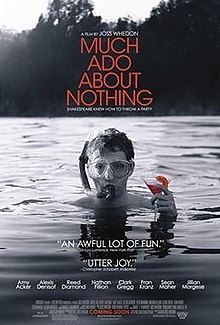
MuchAdo.jpgI was quite prepared to be a little sneery about Joss Whedon’s new film adaptation of this Shakespeare comedy. The early 1990s version, starring Kenneth Branagh and Emma Thompson, is my favourite film version of any Shakespeare play. And hearing that it was filmed in a few days in between Whedon’s more important projects, using lesser known actors from some of Whedon’s earlier TV work, implied that this wasn’t really a serious effort. And some of the earlier reviews seemed to be more excited about seeing the inside of Whedon’s home (used as the location) than about seeing a new Shakespeare adaptation (Much Ado about Whedon’s House…) But all of that is unfair on what is really a wonderfully joyous film.
Returning to the play, Beatrice is probably Shakespeare’s best female character – loyal to her friends, witty and strong. She is stranded in a man’s world that she can’t really change, and given the choice between bitter despondency and surrender (or both), she finds a third way combining cool detachment and humour (‘I had rather hear my dog bark at a crow, than a man say he loves me’). And when only a man can accomplish what she needs most (revenge for the ill-treatment of her cousin), she skilfully uses Benedick’s attraction to her to achieve it. Initially she has similarities with the pre-tamed Katherina from The Taming of the Shrew. But where Katherina is ultimately ‘tamed,’ Beatrice is never less than Benedict’s equal (and she often comes off better in their duels). She isn’t Shakespeare’s only strong woman; Portia in The Merchant of Venice is also a powerful, witty character. But Portia marries an idiot, whereas Beatrice and Benedick are matched perfectly. So their ultimate union is therefore much more satisfying. Benedict’s and Beatrice’s will they/won’t they love story might seem a little stale now, purely because it has been the basis of so many modern rom-coms, but there is so much else happening, and the characters are so much more profound than we would see in the average rom-com, that this play still has the power to move us.
So this is great material and that 1990s film adaptation is my idea of Shakespeare film perfection (except for one small drawback, which I’ll come back to). A cast of great actors; Emma Thompson was at her most alluring, Branagh was showing an early glimmer of the less annoying actor he would eventually turn into full-time, and Denzel Washington, Richard Briers, Kate Beckinsale and Brian Blessed added colour and character. The Tuscan setting is also every middle-class English person’s idea of Eden (I’m not middle-class, but I can still dream). Even the inclusion of Keanu Reeves at his most moronic barely detracted from the sheer loveliness of this film.
So Joss Whedon’s version has a lot to live up to. And early reports – filmed at Whedon’s house in only a few days, the lesser known cast - indicated that it might be an amateurish effort. But if it is amateurish, it is amateurish in the best sense in which the term was originally meant. In the Victorian period, the amateurs were the ones who did it for love and passion, whereas ‘professional’ was often a derogatory term, indicating one who put grubby money ahead of art. England’s cricket team was led by amateurs from their first test in 1877 until they appointed their first professional captain in 1952. Of course, such noble ideals didn’t always work out in reality, and the professional/amateur divide, when it is remembered today, is more often recalled as a time when talented working class professionals were demeaned in order to feed the egos of mediocre, entitled aristocrats. But in its noblest sense, in theory as opposed to employment, the cult of the amateur lauded love over money, and joy over seriousness. Which is all a long (long) way of saying that Whedon’s Ado is amateurish in the finest way possible. The acting is excellent, the Shakespearean language is really brought alive, and every twist and turn of that beautiful language is amplified and underscored, without ever being over-acted or dumbed-down. Shakespearian comedy, which, for me at least, is rarely actually very funny, here had the audience laughing throughout.
The use of actors with minor roles in Buffy and Angel was never a drawback because they all played their parts here with panache and aplomb, and their inclusion gave the audience a little bonus whenever they recognised an old favourite (‘Ah, it’s Drusilla the vampire, but with blonde hair’). Alexis Denisof as Benedick is much better without the irritating English accent he adopted in Angel, and Amy Acker (Beatrice here, Fred from Angel) is a revelation – beautiful, fragile, waspish and funny - she really needs to get some much bigger roles after this. The police were a big improvement even on the 1993 film. In Branagh and Thompson’s version, Dogberry was played by Michael Keaton in a manner more annoying than funny. Here, the police were incredibly dumb but still somehow believable, and very funny too. Finally, Whedon’s house is less impressive on the outside than I expected, but it’s very tastefully decorated inside, and the California style gave it a contemporary ‘nearly Italian’ feel that went well with the play’s setting.
This is a feel-good film that shows that ‘upbeat’ and ‘shallow’ don’t have to go together. It is also a celebration of old-fashioned love that leads to marriage. I left the cinema with a spring in my step, and my one regret at the end was that Whedon ‘wastes’ so much of his time making gigantic blockbusters like the Avengers, instead of focusing on his real vocation of making low budget Shakespeare adaptations.


Thursday, 30 May 2013

Week Five - What Maisie Knew, E Street Cinema

What Maisie Knew, E Street Cinema
What Maisie Knew Poster.jpgI wasn’t at all certain that I really wanted to watch this film. On the one hand, the description I had of it suggested a harrowing story about a sweet little girl suffering at the hands of her horrible, selfish parents. The pain of my own present separation from my kids makes viewing or thinking of anything even remotely comparable almost unbearable. On the other hand it was free. So I went along. The cast of adults were part of the appeal: Juliette Moore is usually great, the Viking vampire from True Blood (Alexander Skarsgård) has a real presence and I’ve liked Steve Coogan since his appearances on The Day Today in the early 1990s (though his serious roles have usually been less successful). The story follows the separation and subsequent activities of a New York couple and their thoughtful young daughter. It never really explains why the parents break up; though their later selfish and thoughtless behaviour towards Maisie suggests reasons (i.e. they are both exceptionally unlikeable). They do show glimmers of humanity and affection early on, before wrecking the appearance later, which also makes us suspicious whenever any other character does something decent.
It might be a good film to make divorcing couples watch as a cautionary tale (‘How not to act in Divorce’). I doubt whether it would make anybody reconsider the divorce itself, but as a powerful list of things that divorcing parents should not do (bad-mouth former spouse to the child, use the child to get back at the ex, let child find out about new boyfriend when he picks her up from school, disappear for long periods and leave child with new step-parents etc), it might at least encourage basic humanity. Perhaps one drawback of using the film like this might be that no divorcing parents would think they could ever be as bad and thus it might instil complacency. When the film starts the mother seems loving, but she quickly shows herself to be a horror. In this respect at least, there is some character development. The dad’s decency lasts a little longer, but still falls by the wayside. This makes is expect everybody to be similarly self-centred, but there were flickers of happiness and wholesomeness, just not from the people who should have been decent. Happiness isn’t elusive in the film and my pre-film fears of a relentless dirge of misery were eventually proven misplaced. But what does happen is that the happiness of day is always followed by the pain of night (usually literally). The step-parents are the most decent, affectionate people in it, but even with them we know that it probably won’t continue indefinitely. The young actress playing Maisie might be criticised a little for underplaying her role - she rarely shows outward signs of sadness - but this made the poor behaviour of her parents all the more affecting. We already knew the bad they were doing, and that it must be damaging Maisie’s soul, so the absence of histrionics simply added to the pathos.
In the fifth-century BC, an Athenian playwright called Phrynichus put on a tragedy showing the sack of Athens’ ally, Miletus. The Athenians were distressed, so on that level at least the play was a success. But the play was on a topic too close to the Athenians’ hearts and it turned out that the people were so distraught that they fined Phrynichus. It was decreed that tragedies should stick to mythological themes in future (which is the case for all of the tragedies that survived to the present). As a modern I should be aghast at this Athenian censoriousness, but actually they did have a point. What Maisie Knew is an effective and moving film, but it was also two of the worst cinematic hours of my life. In the end, although not as miserable as I anticipated, it is still not recommended viewing for anybody already feeling depressed and missing their children. Ultimately the film subverted the entire reason for my cultural calendar and the keeping of this blog - as a distraction from my homesickness.

Saturday, 18 May 2013

Week Four - Star Trek into Darkness & The Three Musketeers at the Synetic Theater

18th May - Star Trek: Into Darkness, AMC Theater, Courthouse Plaza, Arlington

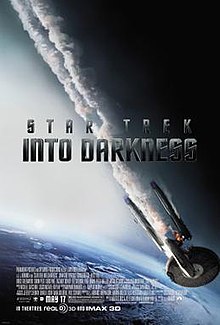
The poster shows a flaming starship falling towards Earth, with smoke coming out. At the middle of the poster shows the title "Star Trek Into Darkness" in dark grey letters, while the production credits and the release date being at the bottom of the poster.I approached the 2011 film of the Hobbit with some trepidation. The book was such a beloved part of my childhood; perhaps more responsible than any other single book for pushing my tastes down the (geeky) path they have taken since. If Peter Jackson had replaced those wonderful memories with something superficial and twisted I would have been distraught. Luckily he didn’t. For some reason there had been no such fears about the 2009 ‘reboot’ of the Star Trek franchise, despite Star Trek, in repeats of the original series, in the film versions with Shatner et al and, perhaps most of all, in the Next Generation incarnation, being an equally well-loved and significant part of my childhood mental furniture. Part of the reason was that Star Trek has never really taken itself seriously (i.e. the Tribble episode of the original series). Partly this was also because there have already been so many frankly awful films made already (at least half of the films with Kirk in, all of the films with Picard in and every TV episode with Scott Bakula as captain). So one doesn’t approach a new Star Trek film expecting great things. Nonetheless the 2009 film confounded my pessimism – most of the actors were excellent replacements and the plot device of the disrupted timeline overcame the major drawbacks of setting a film in an earlier period (i.e. that we normally know what is going to happen). But this means, rarely for a Star Trek film, that Star Trek: Into Darkness begins with the disadvantage of bearing higher expectations. Luckily it fulfils them.

A couple of initial observations. Cumberbatch is best known for playing Sherlock Holmes and the character of Spock is based on Sherlock Holmes, so there was an extra soupçon of enjoyment for Conan Doyle fans in the Spock/Cumberbatch tussles. As an Englishman I almost feel obligated to decry the Hollywood ploy of having heroes talk with American accents and villains sound like posh Englishmen. But, really, deep down we all actually like it. If anybody was going to give Spock and Kirk a run for their money it’s good to know it was Englishman (though I couldn’t really have objected to a Latino choice in this case…) So Cumberbatch is a great villain – tough and fiendishly clever, he joins an elite company of English baddies who we secretly admire (Superman’s General Zod, The Lion King’s Scar, The X-Men’s Magneto, and Christopher Lee as Saruman, Count Dooku, and countless Count Draculas). As an Englishman it was also nice to see that the Union Jack still flies in London in the twenty-third century – I’ll stop worrying about the Scottish independence vote in 2014 now. And the moral qualms felt over Kirk’s mission to kill a terrorist without trial, using log-range photon torpedoes, looks particularly relevant in the week that Obama announced new limits on America’s use of drones to kill terrorists.

My opinions on casting haven’t altered from the 2009 film – Spock, Uhura, Chekhov, and Sulu were and remain fantastic choices. Kirk and Scottie – not so much. I like Simon Pegg in other things, but his Scottish accent is diabolical, his body shape and face are all wrong, and the slapstick comedy attached to his character never hits the right note. Kirk is ok, but not great. I’m doubtful whether anybody else could have really convinced as Kirk, though the news this week that scientists have now successfully cloned human embryos does make one wonder if the reboot should have been put on hold until we could have cloned and raised a new Shatner.

Finally, the plot was predictable in places – it was fairly clear who Cumberbatch was long before it was revealed, and an important plot device from the final segment was also too obvious. Nonetheless, it was a fun film and it definitely found the right mix between adding enough novelty to surprise and amuse us, whilst at the same time keeping enough of the old Star Trek to pull at our nostalgia strings. A welcome addition to the franchise.


18th May - The Three Musketeers at the Synetic Theater, Crystal City


My program informs me that the Synetic Theater’s name derives from its ‘synthesis’ of different art forms and its emphasis on ‘kinetic’, dynamic movement. For a Hellenophile like me, using Greek words gets it off to a good start before I even sit down. The program also describes the Synetic Theater as Washington DCs ‘premier physical theatre,’ though I was less sure of what that would mean in practice (do we have ‘physical theaters’ in England? My cultural education continues…) The theatre is approached from the metro station by the tunnels of Crystal City, which doesn’t make it a particularly scenic walk on a quiet evening - it brought back memories of the chap being chased and eaten on the London Underground in American Werewolf in London. It’s a small venue (‘intimate’ in estate agent and theatre program-speak) and the stage is not what I expected would be the case to produce ‘physical theater’. The music before and during the play is mostly classical, which doesn’t match the avant-garde expectations built up by the program description, but does evoke the atmosphere we expect of seventeenth-century Paris.

The story needs no explanation – there have been plenty of film versions, and for anybody my age the Dogtanian series of the 1980s is still the zenith of musketeer (muskahound?) adaptations, though the Michael York/Oliver Reed versions of the 1970s run it close. Like Star Trek, the humour of the other versions and occasionally awful remakes (i.e. the 2011 film with the flying galleons) mean that you approach any version of Musketeers with realistic expectations – it’s not going to incite any profound insights into the human condition, but as long as it doesn’t take itself seriously and has some good fight scenes you’ll exit satisfied.

This stage version maintained a number of strong points from previous versions, and especially the earthier humour of the 1970s films. Occasionally the comedy didn’t quite come off, and I couldn’t work out whether Porthos was supposed to be a grunting simpleton or a deaf man with simple tastes (he is deaf), but mostly it worked well. The fight scenes were strange though – much more realistic than equivalent scenes from a ballet/dance, but still too stylised to be realistic. The result was dissatisfaction on both counts. The weakest aspect was the dialogue, which was uniformly two-dimensional and stilted. And the acting was mixed. Athos was adequate, Richelieu was good, and the outright comedy roles were excellent (Louis XIII and Aramis especially). None of the female characters ever rose better than average. Milady was at her best whenever she wasn’t speaking – she had two assets for the role but neither of them was her acting ability. In fairness, Milady’s acting was not the worst on show, and as the understudy we might expect that she is not yet the finished article. The actor playing D’Artagnan reminded me most of a successful Hollywood actor. Unfortunately, the actor he reminded me of is Keanu Reeves. And even more unfortunately, it was the Keanu Reeves of Bill and Ted’s Excellent Adventure, not the Keanu Reeves of The Matrix. The combination of naïve idealism, bloodthirsty toughness and comedy is difficult to pull off, but this D’Artagnan never really came close. The best scenes were those which showcased the synthesis and kinesis of the theater’s name. The erotic tango between Milady and Richelieu, in the middle of a chaotic, violent melee, was sublime. Likewise, D’Artagnan’s meeting with the musketeers in a busy crowd was a brilliantly choreographed hybrid of ballet, acrobatics and slapstick. 


The production reached its peaks of fun during the musketeer fighting scenes, but the story’s tragic elements were much less convincing. In summary, the synthesis is not quite balanced yet. A really good writer and some acting lessons would be a good investment before the Synetic produces its next ‘talkie’. But the choreography of movement was fantastic, and I keenly await their silent production of A Midsummer Night’s Dream later in the summer.