Showing posts with label Arlington. Show all posts

Sunday, 1 September 2013

Final Post - Top Nine DC Sights

Top Nine DC Sights

Ok, it seems a shame to sign off with the rather rushed review of the Free For All Much Ado About Nothing (excellent though it was), so here is my final post on DC, written in the comfort of my living room in England. This final list of DC sights includes those that were not covered in my other reviews or, mostly, covered in the post on the sights explored when my family visited.

1)  The Library of Congress – this has already been mentioned  in my ‘family sights’ post, but it gets in twice because I’ve been working there, and it really does have some great artefacts that I didn’t mention before. Even beyond the great works from America’s earliest days, the Library also displays some incredibly important global books – like the Gutenberg Bible, the first great book to be printed, which sits in the Great Hall opposite the Giant Bible of Mainz, the last of the great handwritten books from the days before printing. And the Jefferson Building itself is impressive. The Great Hall and the Main Reading Room are worth a trip in themselves.

2) The National Gallery is another wonderful building. The neo-classical architecture can get a bit same-y but the East Building is a modernist marvel, and the interiors of both are perfect, especially the in-door seating/arboretum areas upstairs in the West Building. Art-wise, the dearth of Georges Braque works was a little disappointing but it was made up for by the El Grecos – these really are dazzling. I was walking past their room when I caught a glimpse and then I had to examine them. Hundreds of years ahead of their time, these were the highlight of my visit.

3) The Phillips Collection. A special Braque still life exhibit was on during my visit, which was beautiful. A lot of cubism can be quite depressing, but these works from the late 20s to the 40s manage to be both profound and uplifting. There is also another wonderful El Greco here too. The building was clearly grand as a house but as a gallery it feels almost intimate compared to the National. Well worth a visit.


4) Arlington Cemetery  - I didn’t get to find the grave of Orde Wingate (the man who created the Chindits and led my granddad against the Japanese in Burma in WW2) who is buried there, but a moving trip nonetheless.

5) Ford’s Theatre (where Abraham Lincoln was shot) – great after hours tour by Charlotte Reineck – it’s not a period of history I know much about (and Abraham Lincoln: Vampire Hunter isn’t as much use as you might wish), but this tour was informative enough that I came away knowing a lot more about it, but entertaining enough that I didn’t feel overwhelmed with facts.

     6) Baseball games at the Nationals Park. The really weird thing here, which you would never guess from the mobs of devoted fans attending on a Friday evening, is that DC has only had its own Major League Baseball team for a few years. Before 2005, most Washington residents supported the Baltimore Orioles (and many apparently still do). For somebody, like me, who watches his local cricket team struggle to get a few hundred spectators turn up for a first class match, the fact that so many Americans can get so excited so often (they have around 80 home games a season!) is truly impressive. I watched a mere three of their home games, but each one was lots of fun, although I’m still a little dubious about the nutritional value of the Half Smoke

      7)  Freer Gallery – Asian art is not normally my thing, but this place has such an excellent collection, it is so stylishly laid out and it is such a calm
      and cool pool of tranquillity on a hot DC day, that you cannot help but fall for the pieces on display. The inclusion of western artworks inspired by Asian artefacts, like Whistler's Asian influenced scenes of London, was also
      surprisingly successful. And these beautiful Chinese jade artefacts from the neolithic period were new to
      me.

8) Dumbarton Oaks. This is definitely worth a visit whether you enjoy beautiful old houses, delightfully peaceful and charming English-style country gardens, or wonderfully idiosyncratic museums (a museum focusing only on pre-Columbian American art and Byzantine art doesn’t sound like it would work, but it really does). And it’s in Georgetown, so you can check out one of DCs best areas for shops, bars and restaurants too.


9) Great places for a drink that really should have appeared in House of Cards. The Capitol Hill Club (you’ll need a member to accompany you inside), the Old Ebbitt Grill, and the Teddy and the Bully. Teddy Roosevelt plays a prominent role in the latter two establishments (and there is at least one painting of him in the Capitol Hill Club), including the heads of a bunch of animals he shot in the Old Ebbitt Grill (which makes it sound worse than it is).


So that’s it for my trip to Washington, DC. It hasn’t transformed me into a Renaissance Gentleman, as I had hoped it would, but it’s been a lot of fun and it’s kindled an interest in theatre which I hope to maintain (my first trip to Stratford upon Avon to see some Shakespeare is already booked). As big cities go, Washington is one of the best.

Thursday, 1 August 2013

Week Fifteen, A Midsummer Night's Dream

1st August 2013, A Midsummer Night’s Dream at the Synetic Theater

This is my second visit to ‘DC’s premier physical theater’ so I had a fair idea of what I would be getting. The Synetic’s speciality is wordless theatre, telling stories though action alone. My first visit was for a performance of The Three Musketeers which included some dialogue alongside the dance though, so I wasn’t getting the full-force of the Synetic experience in that show. In that earlier case, the dance/mime aspects were better than the spoken sections, so my expectations for a full dance/mime play were high. Even the thought of seeing a ‘daring’ and ‘innovative’ interpretation of Shakespeare doesn’t cause me the usual fear, for the simple reason that A Midsummer Night’s Dream is one of my least favourite Shakespeare plays. They could have distorted the story as much as they fancied without blighting any beloved memories of mine.

The performance opened in darkness, with unseen dancers moving, seemingly haphazardly, across the stage holding small lights. It was as though a swarm of fireflies were floating frenetically in the night. But as the stage grew lighter, the music took on a tenor suggestive of eastern mysticism, the performers moving like Indian temple dancers and the lights now obviously mini electric candles, evocative of Diwali, the Festival of Lights. Finally, two more dancers emerged, more gloriously arrayed than the others, Titania and Oberon. But Titania as Hindu Goddess. There then follows a bizarre prologue to the play in which we see Puck being born (fully grown) years earlier from a mother who then dies, leaving him to be reared by the faerie monarchs.

Outlandish and captivating so far.

Then the story cut to the more prosaic present, in Athens, where Hermia is due to be married by Duke Theseus to Lysander. But Hermia really wants to marry Demetrius and Hermia’s friend Helena wants to marry Lysander (but he’s seemingly in love with Hermia). So there follows the standard Shakespearean story of the youngsters fleeing into the woods where they are the focus of Puck’s mischievous magic, and all is chaos until the denouement when everybody loves the person they are supposed to love and Theseus agrees to let them all be married. Along the way we have the domestic tiff between Oberon and Titania and the incredibly dull sections with Bottom and his fellow actors. All told without words.

The Synetic is a small theatre and for this show I’d bagged an especially good central second row seat from which to appreciate the physicality of cutting edge dance. I was not disappointed. There are some fantastic uses of movement to create illusion, such as the early section with Demetrius running on the spot and somebody running past him breaking paper doors over him to create the illusion that Demetrius is running through a building and barging through doors (you probably had to be there). Titania and Oberon’s battle over Puck, with the three actors suggesting magical forces at play purely from their own movements, was delightful and stunning. The crowded movement scenes, as in The Three Musketeers, were the most engaging, and another excellent scene was that when the enchanted Demetrius and Lysander were fighting over Helena and fighting off Hermia. There was lots of playfully raunchy humour in that scene too (more Benny Hill than anything actually erotic), which was charming in its knowing innocence. But Puck (Alex Mills), even when alone on the stage, was the real star of the show throughout. Whether climbing up a rope, jumping onto the moon, doing back-flips, contorting himself like a yogi or walking around on his hands, every leap and twist was so natural and, seemingly, effortlessly that one could not help but be impressed. The scene where is was seemingly being pulled all over the stage by a small flower in his hand sounds pretty feeble in description, but actually both funny and beautiful. Really.

Of course, Shakespeare is rightly loved for the power of his words, so you can’t take all the words out and expect every single thing to be hunky dory. For one thing, the performers’ actions have to be extremely obvious to make sure everybody sees them, especially when there are multiple actors on the stage. The jokes were often particularly banal (fart noises, really?), such as depicting Helena’s unrequited longing by having her swig dramatically from an oversized bottle whisky and Hermia overacting when appearing drunk at her engagement party. Shakespeare was at fault for the most tedious, cringe-worthy sections, which were the scenes involving Bottom and the play within a play. These sections are the key reason, for me, that the play doesn’t keep me gripped whoever is performing it. Dull with dialogue, dull without. Nonetheless, there were a number of laugh out loud moments, especially relating to Helena’s attempted wooing of Lysander. The actress playing Helena (Emily Whitworth) has a real gift for comedy.

One of the strongest aspects of the performance was the original score by Constantine Lortkipanidze, who really ought to be scoring major films. The music always added to, and never distracted from, the action. He also had a small part in the cast as the pianist accompanying Bottom’s play, where his musical accompaniment was the highlight (indeed, the only light) of those otherwise dull sections.

Overall, it wasn’t always as funny as I might have liked, but I was still swept along by sheer admiration for the acrobatic feats of dance and movement. For me, this made a bad Shakespeare play watchable. I would love to see a Synetic version of a Shakespeare play that I actually like, but unfortunately I’ll be leaving before the new season begins. The Synetic gives me one more reason to return to DC in the future.

Saturday, 18 May 2013

Week Four - Star Trek into Darkness & The Three Musketeers at the Synetic Theater

18th May - Star Trek: Into Darkness, AMC Theater, Courthouse Plaza, Arlington

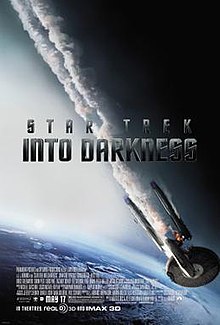
The poster shows a flaming starship falling towards Earth, with smoke coming out. At the middle of the poster shows the title "Star Trek Into Darkness" in dark grey letters, while the production credits and the release date being at the bottom of the poster.I approached the 2011 film of the Hobbit with some trepidation. The book was such a beloved part of my childhood; perhaps more responsible than any other single book for pushing my tastes down the (geeky) path they have taken since. If Peter Jackson had replaced those wonderful memories with something superficial and twisted I would have been distraught. Luckily he didn’t. For some reason there had been no such fears about the 2009 ‘reboot’ of the Star Trek franchise, despite Star Trek, in repeats of the original series, in the film versions with Shatner et al and, perhaps most of all, in the Next Generation incarnation, being an equally well-loved and significant part of my childhood mental furniture. Part of the reason was that Star Trek has never really taken itself seriously (i.e. the Tribble episode of the original series). Partly this was also because there have already been so many frankly awful films made already (at least half of the films with Kirk in, all of the films with Picard in and every TV episode with Scott Bakula as captain). So one doesn’t approach a new Star Trek film expecting great things. Nonetheless the 2009 film confounded my pessimism – most of the actors were excellent replacements and the plot device of the disrupted timeline overcame the major drawbacks of setting a film in an earlier period (i.e. that we normally know what is going to happen). But this means, rarely for a Star Trek film, that Star Trek: Into Darkness begins with the disadvantage of bearing higher expectations. Luckily it fulfils them.

A couple of initial observations. Cumberbatch is best known for playing Sherlock Holmes and the character of Spock is based on Sherlock Holmes, so there was an extra soupçon of enjoyment for Conan Doyle fans in the Spock/Cumberbatch tussles. As an Englishman I almost feel obligated to decry the Hollywood ploy of having heroes talk with American accents and villains sound like posh Englishmen. But, really, deep down we all actually like it. If anybody was going to give Spock and Kirk a run for their money it’s good to know it was Englishman (though I couldn’t really have objected to a Latino choice in this case…) So Cumberbatch is a great villain – tough and fiendishly clever, he joins an elite company of English baddies who we secretly admire (Superman’s General Zod, The Lion King’s Scar, The X-Men’s Magneto, and Christopher Lee as Saruman, Count Dooku, and countless Count Draculas). As an Englishman it was also nice to see that the Union Jack still flies in London in the twenty-third century – I’ll stop worrying about the Scottish independence vote in 2014 now. And the moral qualms felt over Kirk’s mission to kill a terrorist without trial, using log-range photon torpedoes, looks particularly relevant in the week that Obama announced new limits on America’s use of drones to kill terrorists.

My opinions on casting haven’t altered from the 2009 film – Spock, Uhura, Chekhov, and Sulu were and remain fantastic choices. Kirk and Scottie – not so much. I like Simon Pegg in other things, but his Scottish accent is diabolical, his body shape and face are all wrong, and the slapstick comedy attached to his character never hits the right note. Kirk is ok, but not great. I’m doubtful whether anybody else could have really convinced as Kirk, though the news this week that scientists have now successfully cloned human embryos does make one wonder if the reboot should have been put on hold until we could have cloned and raised a new Shatner.

Finally, the plot was predictable in places – it was fairly clear who Cumberbatch was long before it was revealed, and an important plot device from the final segment was also too obvious. Nonetheless, it was a fun film and it definitely found the right mix between adding enough novelty to surprise and amuse us, whilst at the same time keeping enough of the old Star Trek to pull at our nostalgia strings. A welcome addition to the franchise.


18th May - The Three Musketeers at the Synetic Theater, Crystal City


My program informs me that the Synetic Theater’s name derives from its ‘synthesis’ of different art forms and its emphasis on ‘kinetic’, dynamic movement. For a Hellenophile like me, using Greek words gets it off to a good start before I even sit down. The program also describes the Synetic Theater as Washington DCs ‘premier physical theatre,’ though I was less sure of what that would mean in practice (do we have ‘physical theaters’ in England? My cultural education continues…) The theatre is approached from the metro station by the tunnels of Crystal City, which doesn’t make it a particularly scenic walk on a quiet evening - it brought back memories of the chap being chased and eaten on the London Underground in American Werewolf in London. It’s a small venue (‘intimate’ in estate agent and theatre program-speak) and the stage is not what I expected would be the case to produce ‘physical theater’. The music before and during the play is mostly classical, which doesn’t match the avant-garde expectations built up by the program description, but does evoke the atmosphere we expect of seventeenth-century Paris.

The story needs no explanation – there have been plenty of film versions, and for anybody my age the Dogtanian series of the 1980s is still the zenith of musketeer (muskahound?) adaptations, though the Michael York/Oliver Reed versions of the 1970s run it close. Like Star Trek, the humour of the other versions and occasionally awful remakes (i.e. the 2011 film with the flying galleons) mean that you approach any version of Musketeers with realistic expectations – it’s not going to incite any profound insights into the human condition, but as long as it doesn’t take itself seriously and has some good fight scenes you’ll exit satisfied.

This stage version maintained a number of strong points from previous versions, and especially the earthier humour of the 1970s films. Occasionally the comedy didn’t quite come off, and I couldn’t work out whether Porthos was supposed to be a grunting simpleton or a deaf man with simple tastes (he is deaf), but mostly it worked well. The fight scenes were strange though – much more realistic than equivalent scenes from a ballet/dance, but still too stylised to be realistic. The result was dissatisfaction on both counts. The weakest aspect was the dialogue, which was uniformly two-dimensional and stilted. And the acting was mixed. Athos was adequate, Richelieu was good, and the outright comedy roles were excellent (Louis XIII and Aramis especially). None of the female characters ever rose better than average. Milady was at her best whenever she wasn’t speaking – she had two assets for the role but neither of them was her acting ability. In fairness, Milady’s acting was not the worst on show, and as the understudy we might expect that she is not yet the finished article. The actor playing D’Artagnan reminded me most of a successful Hollywood actor. Unfortunately, the actor he reminded me of is Keanu Reeves. And even more unfortunately, it was the Keanu Reeves of Bill and Ted’s Excellent Adventure, not the Keanu Reeves of The Matrix. The combination of naïve idealism, bloodthirsty toughness and comedy is difficult to pull off, but this D’Artagnan never really came close. The best scenes were those which showcased the synthesis and kinesis of the theater’s name. The erotic tango between Milady and Richelieu, in the middle of a chaotic, violent melee, was sublime. Likewise, D’Artagnan’s meeting with the musketeers in a busy crowd was a brilliantly choreographed hybrid of ballet, acrobatics and slapstick. 


The production reached its peaks of fun during the musketeer fighting scenes, but the story’s tragic elements were much less convincing. In summary, the synthesis is not quite balanced yet. A really good writer and some acting lessons would be a good investment before the Synetic produces its next ‘talkie’. But the choreography of movement was fantastic, and I keenly await their silent production of A Midsummer Night’s Dream later in the summer.