Sunday, 21 July 2013

Week Thirteen, Oscar Wilde's Salomé

21st July 2013 – Oscar Wilde’s Salomé at the Atlas Theater on H Street, DC

Salomé is not Wilde’s usual subject matter. The plot involves the step-daughter of Herod attempting to seduce John the Baptist and then encompassing his death by beheading when John rebuffs her. It was also originally in French, but the differences between Salomé and Wilde’s other plays go far beyond the original languages in which they were written and the contrasting subject matter. Whereas Wilde’s other plays are characterised by their playful, witty, lightness of touch, Salomé is much darker and, dare I say, the dialogue plods rather than frolics. Whereas plays like The Importance of Being Ernest are zany portrayals of pragmatic people, Salomé is symbolic and brooding, full of nightmarish imagery and weird, ominous repetitions. The moon is constantly alluded to and referenced in the dialogue, sometimes as a beautiful ‘silver flower’ or a virgin, but more and more ominously as the play progresses (regresses?) The moon was like a ‘mad woman searching everywhere for lovers’ (like Salomé), or as a pallid herald of death: ‘like the hand of a dead woman, covering her face with a shroud.’

Herod (Brian Hemmingsen) and Salomé (Irina Koval)
Salomé’s dance for Herod isn’t exactly erotic, and one can’t really imagine any genuinely red-blooded man going wild for it, but it is a beautiful, elegant expression of something. Maybe it’s symbolic of eroticism in the abstract. Herod (Brian Hemmingsen) is interesting too. He looks like a Sicilian thug but he talks with the subtlety of the Godfather. Only his leers toward his young step-daughter hint at the animal inside. John the Baptist (or Iokanaan as he is called here) is powerfully portrayed, but his constant shouted interruptions – no doubt symbolic of something or other - are the ultimate discordant mood-killer. The 1920s cocktail party setting makes provides a quality of Wildean sophistication in a roundabout way (well, Noel Coward-ish, which is close enough). But there is also a sort of 1980s vibe as well (and the 1920s setting contributed to that atmosphere – the 20s were big in the 80s). The stilted, symbolic language and stark staging are also in the vein of every BBC 2 arty television play of the 80s. The white face paint symbolically reflected the moon motif, but it also prompted memories of all those Pierrot pictures which were so popular amongst 1980s teenage girls (my older sister had a couple in her room).

So there were interesting aspects and some excellent performances, but I left frustrated.

This is a small theatre with a low budget and a cast of relative unknowns, so it would be easy to blame the shortcomings of this performance, and the disappointment of the viewer, upon the cast and theatre. But that would be a mistake. The strengths here - like the zesty coquettishness of Salomé, the eerie dream quality of the young Syrian - were due to the production. The main weaknesses were the work of Wilde. It is to his credit that he continued to experiment even after the seemingly effortless success of his ‘normal’ plays. But this is really not his best work.

Next week: The Book of Mormon at the Kennedy Center.

Saturday, 13 July 2013

Week Twelve, Much Ado About Nothing

13th July 2013 - Joss Whedon's Much Ado About Nothing at E Street Cinema, DC

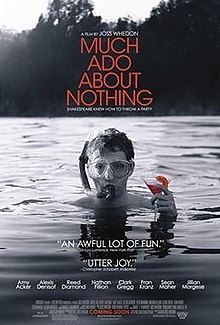
MuchAdo.jpgI was quite prepared to be a little sneery about Joss Whedon’s new film adaptation of this Shakespeare comedy. The early 1990s version, starring Kenneth Branagh and Emma Thompson, is my favourite film version of any Shakespeare play. And hearing that it was filmed in a few days in between Whedon’s more important projects, using lesser known actors from some of Whedon’s earlier TV work, implied that this wasn’t really a serious effort. And some of the earlier reviews seemed to be more excited about seeing the inside of Whedon’s home (used as the location) than about seeing a new Shakespeare adaptation (Much Ado about Whedon’s House…) But all of that is unfair on what is really a wonderfully joyous film.
Returning to the play, Beatrice is probably Shakespeare’s best female character – loyal to her friends, witty and strong. She is stranded in a man’s world that she can’t really change, and given the choice between bitter despondency and surrender (or both), she finds a third way combining cool detachment and humour (‘I had rather hear my dog bark at a crow, than a man say he loves me’). And when only a man can accomplish what she needs most (revenge for the ill-treatment of her cousin), she skilfully uses Benedick’s attraction to her to achieve it. Initially she has similarities with the pre-tamed Katherina from The Taming of the Shrew. But where Katherina is ultimately ‘tamed,’ Beatrice is never less than Benedict’s equal (and she often comes off better in their duels). She isn’t Shakespeare’s only strong woman; Portia in The Merchant of Venice is also a powerful, witty character. But Portia marries an idiot, whereas Beatrice and Benedick are matched perfectly. So their ultimate union is therefore much more satisfying. Benedict’s and Beatrice’s will they/won’t they love story might seem a little stale now, purely because it has been the basis of so many modern rom-coms, but there is so much else happening, and the characters are so much more profound than we would see in the average rom-com, that this play still has the power to move us.
So this is great material and that 1990s film adaptation is my idea of Shakespeare film perfection (except for one small drawback, which I’ll come back to). A cast of great actors; Emma Thompson was at her most alluring, Branagh was showing an early glimmer of the less annoying actor he would eventually turn into full-time, and Denzel Washington, Richard Briers, Kate Beckinsale and Brian Blessed added colour and character. The Tuscan setting is also every middle-class English person’s idea of Eden (I’m not middle-class, but I can still dream). Even the inclusion of Keanu Reeves at his most moronic barely detracted from the sheer loveliness of this film.
So Joss Whedon’s version has a lot to live up to. And early reports – filmed at Whedon’s house in only a few days, the lesser known cast - indicated that it might be an amateurish effort. But if it is amateurish, it is amateurish in the best sense in which the term was originally meant. In the Victorian period, the amateurs were the ones who did it for love and passion, whereas ‘professional’ was often a derogatory term, indicating one who put grubby money ahead of art. England’s cricket team was led by amateurs from their first test in 1877 until they appointed their first professional captain in 1952. Of course, such noble ideals didn’t always work out in reality, and the professional/amateur divide, when it is remembered today, is more often recalled as a time when talented working class professionals were demeaned in order to feed the egos of mediocre, entitled aristocrats. But in its noblest sense, in theory as opposed to employment, the cult of the amateur lauded love over money, and joy over seriousness. Which is all a long (long) way of saying that Whedon’s Ado is amateurish in the finest way possible. The acting is excellent, the Shakespearean language is really brought alive, and every twist and turn of that beautiful language is amplified and underscored, without ever being over-acted or dumbed-down. Shakespearian comedy, which, for me at least, is rarely actually very funny, here had the audience laughing throughout.
The use of actors with minor roles in Buffy and Angel was never a drawback because they all played their parts here with panache and aplomb, and their inclusion gave the audience a little bonus whenever they recognised an old favourite (‘Ah, it’s Drusilla the vampire, but with blonde hair’). Alexis Denisof as Benedick is much better without the irritating English accent he adopted in Angel, and Amy Acker (Beatrice here, Fred from Angel) is a revelation – beautiful, fragile, waspish and funny - she really needs to get some much bigger roles after this. The police were a big improvement even on the 1993 film. In Branagh and Thompson’s version, Dogberry was played by Michael Keaton in a manner more annoying than funny. Here, the police were incredibly dumb but still somehow believable, and very funny too. Finally, Whedon’s house is less impressive on the outside than I expected, but it’s very tastefully decorated inside, and the California style gave it a contemporary ‘nearly Italian’ feel that went well with the play’s setting.
This is a feel-good film that shows that ‘upbeat’ and ‘shallow’ don’t have to go together. It is also a celebration of old-fashioned love that leads to marriage. I left the cinema with a spring in my step, and my one regret at the end was that Whedon ‘wastes’ so much of his time making gigantic blockbusters like the Avengers, instead of focusing on his real vocation of making low budget Shakespeare adaptations.


Monday, 8 July 2013

Weeks Eight to Eleven, Top Seven Family Friendly Cultural Highlights in DC 2013

Ok, so nothing too highbrow during this period as my partner and our two daughters were visiting from England. When your priority is finding fun things for a 4 year old and a two year old to do, culture takes a back seat. So I haven't included excursions like the one to the Zoo but, even so, we managed to fit in a few things and here are the 'Top Seven Family Friendly Cultural Highlights in DC 2013' (in no particular order):


1) Breakfast at a Diner in Georgetown, bit of shopping, kids play in the big fountain, then a water-taxi from Georgetown to Alexandria and a visit to the Torpedo Factory Art Center.


2) Garden Fête at the French Embassy. Live bands, delicious pastries and the girls dancing away past their bedtimes...


Very hot day, so the in-door piano recital for a respite and relax was a bonus too.

3) Trip to the Kennedy Center for a free concert by Esther Biro and her Hungarian folk Klezmer band. One child fell asleep but everybody else enjoyed it, and you get good views of DC from the balcony.


4) Natural History Museum. Free entry, stacks of interactive stuff, educational and fun. It also helps if your kids have seen the Night at the Museum films.


5) Not actually in DC, but a pleasant train journey away: sightseeing in New York and an afternoon in Central Park.


6) Visit to the Library of Congress to enjoy the architecture, see where daddy works and play with the toys and books in the Children's Reading Room.


 7) Not, perhaps, that cultural: outdoor dinner at Clare and Don's Beach Shack whilst listening to the upbeat country sound of the 'DC Three.' Great food, though I suspect my deep fried Oreo and ice cream may have added a pounds...


Sunday, 9 June 2013

Week Seven, Men Behaving Oddly Part Two - The Guardsman

9th June 2013,Ferenc Molnar’s The Guardsman at the Kennedy Center

Jealous men behaving oddly was the theatrical theme of the week. After the unfounded jealousy and excessive response of a king in The Winter’s Tale, today I enjoyed the understandable jealousy and extraordinary response of a thespian in The Guardsman. These contrary responses to what is, at some point in all our lives, a universally experienced emotion, nonetheless both expressed the primal power of betrayed love. In The Guardsman, the plot revolves around a famous theatrical couple in early 1900s Budapest. The actress (Sarah Wayne Collies, from TVs The Walking Dead and Prison Break) has a promiscuous past in which she took many lovers but discarded them after six months. She has now apparently settled down to domesticity with her husband (Finn Wittrock). But as their six month anniversary approaches, the husband begins to notice or imagine changes in his wife’s behaviour, which lead him to suspect that she is ready to discard him too. When he finds out that her fantasy man is a military officer with a sensitive side, he begins to send her flowers and notes from a mysterious imperial guardsman. He then tells her that he will be out of town for a few days; he puts on his guardsman disguise and arranges to meet his wife to see if she will be seduced by the guardsman. As his alter-ego’s attempts at seduction continue, the actor grows more and more jealous of the non-existent guardsman. Clearly flattered by the attentions of the exciting stranger, his wife at first resists his attempts but eventually begins to succumb…

After seeing a number of Shakespeare productions set in different periods, it was at least refreshing to see that a play written in the Budapest of the early 1900s was actually set in the Budapest of the early 1900s. And the stage design was excellent. Most of the play takes place in an upper middle class drawing room, with the remainder set in a box at the opera, and both locations were gorgeously represented. In the drawing room, La Belle Époque art hung on scarlet walls, the actress played Chopin on the grand piano, and the stage was liberally adorned with elegant Parker Knoll type armchairs, lavish floor cushions and chaise longues. The whole thing effortlessly called forth that central European bourgeois, Bohemian world which was eventually flattened to make way for the great, grey, grim utopia of communist dreams.

The program also made promising reading. The original Guardsman was written by Molnar Ferenc as a dark and bitter black comedy, which the 1920s Broadway adaptation turned into a light and airy farce. Ferenc was inspired to write the play by his real-life abandonment by his actress-lover (who eventually went on to play the lead role The Guardsman). Ferenc attempted to kill himself and then wrote this raw, dark play whilst recovering in hospital. So this production is based on a new translation designed to add the ‘black’ back to the comedy. And this is where the first problems arise: the husband-wife bickering is too intense, too realistic, to be funny. And after we have endured 20 minutes of anguished wrangling, the surreal, madcap elements of the play aren’t really strong enough to lift us back up. In returning the original agony, this adaptation loses too much of the funniness.

Nonetheless, even with this fundamental weakness, the play might have recovered in the second act, when the deception and ambiguity really get going. Collies is certainly enough of an attractive actress to play the role of an attractive actress. I’m not sure she had that ‘it’ factor which the dialogue suggests she needed, but she played her part competently and expressed her emotions with the passion and subtlety demanded. The family friend and ineffective admirer of the actress (Shuler Hensley), got many of the best lines, and he delivered them with great timing and the sardonic dryness of the lovelorn stoic. The husband though, on whose shoulders the success of this production really rested, was poorly cast. When out of disguise, his voice and accent were more evocative of a character from Dude, Where’s My Car? than that of a successful but desperate European man of the world. But his accent as the guardsman was much, much worse. Somebody, somewhere obviously thought that giving the guardsman a thick and ridiculous east European accent would add an extra element of humour to proceedings. Perhaps the director is a fan of Borat. In any event, the result was annoyance every time he opened his mouth. Finally, and as a proud little person myself it pains me to say it, the actor was too short to play a dashing military officer. The actress was a good three inches taller than him and the height mismatch undermined the entire effect. I could suspend my disbelief enough to believe that she wouldn’t recognize her own husband if he put on a fake moustache and a silly accent, but that this worldly-wise glamorous fox would fall so quickly under the spell of a bumbling short guy? No. A taller actor, or at the very least a short actor in a pair of Cuban heels, was needed.

The contrast between the male leads’ responses to their suspicions in The Winter’s Tale and The Guardsman goes beyond their initial actions (soaring anger for the king, and sly, fretful capering for the actor). Leontes recognized his stupidity quite early on. Once forgiven by his much put-upon spouse, the play ends with the audience understanding that their relationship is secure. The Guardsman is in some ways more problematic and it ends much more ambiguously. I overheard completely different interpretations of the ending by different audience members on the way out. With a few more laughs and a taller actor in the lead, this would be a great and intriguing play.

Wednesday, 5 June 2013

Week Seven, Men Behaving Oddly Part One - The Winter's Tale

05th June, Shakespeare’s The Winter’s Tale, Lansburgh Theatre (ShakespeareTheatre Company)


Winter's Tale, The
I have never really seen The Winter’s Tale before, so I was looking forward to this. That ‘really’ was added because I have kind of seen it performed by children aged 3 to 7 at the Royal Shakespeare Company Theatre in Stratford. So I thought I had a rough idea of the plot (which turned out to be a very good idea of the plot – well done kids!), but now just wanted to see what some ‘proper’ grown up actors would make of it.

This production was at the Lansburgh Theater, which is the third venue I’ve visited for Shakespeare in DC and also the third most interesting. It’s smaller than the Harman, both in seating and the stage, but nowhere near as quirky as the Folger. In this production, the set is suggestive of a posh neo-classical country house drawing room, and the royal household of King Leontes are all dressed smartly, which gives it the feel of an episode of Agatha Christie’s Poirot. Being one of Agatha Christie’s biggest fans, this is an early point in the production’s favour. It’s also quite apt as Hermione is played by an actress (Hannah Yelland) whom the program informs me has appeared in Poirot. She did look familiar and so did Leontes (Mark Harelik) – I couldn’t decide whether I had seen him on television or if it was just because he reminded me of Rupert Everett, but it turns out he plays the boss of the physics department in The Big Bang Theory. So this is my first American Shakespeare with actors I have seen on the telly. They’re not exactly John Lithgow, but it’s something. The country house weekend mood is maintained with the drinking from decanters and the slightly tipsy behaviour.

This quite pleasant Edwardian/Wodehouse ambience is ominously interrupted by Leontes’ increasingly paranoid asides, and the dark effect is accentuated with strange, David Lynch-like noises (think the nightmarish bits from Mulholland Drive) and eerie pale blue lighting, which suggests more than a hint of some shadowy psychosis. This suggestion of mental imbalance is useful because from the dialogue alone we never really get a satisfactory explanation for Leontes’ sudden, groundless, and deadly suspicion. He seems to be comfortable in his world and his power is absolute. This is no Othello and there is no Iago to whisper poison in his ear. At the same time, the fear of unfaithfulness must be almost universal, and one could imagine it eating away at a mind that can get its way on every other issue but that. So this is a study in paranoia; even when a loyal and beloved servant attempts to use reason to defuse his suspicion, Leontes can only say ‘thou liest Camillo and I hate thee’.

In the first half this is a tale of misery, as has been suggested by Leontes’ son in the first scene, who says that ‘a sad tales’ best for winter’. So this play seems at first to be the inverse in all respects of A Midsummer Night’s Dream. But in that case we would expect the tragic elements to continue throughout, which isn’t so. The play is set up for tragedy but ends as comedy, making it a little disconcerting for the audience. The first half is tragic without, except for some words of Hermione’s, enough of the redeeming nobility of tragedy. But the second half is a farce. Rather than attempt to bring those parts together into a harmonious whole, for example by downplaying the most poisonous aspects of the first half and emphasising the dramatic and serious aspects of the second half, this production deepens and widens the chasm between the two worlds. In the first half, the horror of Leontes’ behaviour is played for all it is worth. The stage reflects the obsessive suspicion of his poisoned mind and the actor’s performance is physical enough to shock. Sitting in the second row was an incredibly uncomfortable experience at times as the entire atmosphere took on the suffocating closeness of a broken marriage under the shadow of domestic violence. The death of their son, the end of Leontes friendship with Polixenes, even the trial of Hermione, felt weightless in comparison with the pulsating rage and barely contained power of Leontes when he at one point flew across the stage to grab Hermione. Likewise, the second half contained added elements of physical farce and comedy, so the contrast between the two halves was dramatic, but not necessarily successful. Whilst the farce gave emotional relief, it did not really ‘make right’ or justify the action from the first half. The setting seems odd too, being set in Sicily with seaborne visits to landlocked Bohemia. The names are mostly Greek, rather than Sicilian or Bohemian (unless it is set in the ancient world when Sicily was Greek, but then that was before Bohemia existed). They swear by a mix of Roman and Greek gods: ‘By Jove’, ‘Apollo be my Judge’ and then they send to the Greek Delphic Oracle. So it is set in a hybrid world of ancient/modern, Greek/Roman.

This play has also sometimes been criticised for the meek portrayal of the female characters, especially Hermione. She doesn’t hesitate to forgive Leontes for his atrocious behaviour, which seems a little too easy on Leontes. But this is unfair. He has, after all, spent 16 years in miserable repentance. And if we follow the hints that Hermione has been alive the whole time in Paulina’s house, then it would seem that she could have revealed herself much earlier once she knew he was sorry. The fact that she waited so long suggests that she has already punished him, so there is no longer any need to cast a shadow over their reunion. There is also the issue that Shakespeare was writing in a man’s world. To say that women in such a world sometimes have to meekly accept injustice is not necessarily to endorse that world (and the goodness of Hermione, contrasted with the mad tyranny of Leontes could easily be read as criticism of male dominance). And the character of Paulina is the strongest in the play, much more forceful than her husband Antigonus, more just than King Leontes and, through her protection of Hermione, wiser than all of them. When Leontes asks Antigonus ‘canst thou not rule her?’, the answer for the audience is an emphatic and clear, ‘no he canst not’!

The program flagged up the apparently innovative (but also authentic) use of double roles for most of the actors, but I’m not sure we really gained much from it. On paper, pairing Leontes with Autolycus seems apt – Autolycus is the fool of Bohemia and Leontes has shown himself a kingly fool in Sicily. But mostly there was no real connection between the Sicilian and Bohemian pairings. And one of them was frankly odd without being interesting. The prince Murmillo and princess Perdita were played by the same actress, which had a superficial logic in that they were brother and sister, one born around the time the other died. And I have nothing at all against actors taking on different genders, which after all was done all the time by Shakespeare. But for a girl to play a boy the girl should at least look fairly boyish, which was really not the case here, with a Rubens-esque young lady playing the male child Murmillo. The actor portraying Florizel came across as weak and dainty, rather than dashing and princely, but fortunately he is not a key character.

The eccentricities of the plot have inspired me to develop my own, probably wrong and definitely un-provable, theory of its creation. The reasons for the kings jealousy are never explained, and we never really know for sure that Hermione is innocent, thought that is surely the conclusion we are pointed to. I believe that this play started out as an idea for a history play on Henry VIII – that towering figure of the Tudor period and renowned doubter of female fidelity. So Hermione is the adulteress Anne Boleyn, Perdita is Queen Elizabeth, and the emphasis towards the end on a King’s duty to remarry and beget an heir is both a reflection of Henry’s on-going quest to father princes and a reflection of the worry in Elizabethan England about what chaos and strife might follow upon the approaching death of the childless Elizabeth. But Shakespeare was much too sensible to put on such a play that might offend his monarch. Thus the names and locations are changed. Even so, to further reduce the dangers to Shakespeare’s life, the plot is then changed midway from tragedy to comedy, and becomes a fantasy about what would have happened if Anne Boleyn had been innocent and had not really died.

Anyway…
… The Winter’s Tale is not one of Shakespeare’s best plays, and I would guess that it came early on in the period when Shakespeare was experimenting with tragi-comedies. But it is still an absorbing journey into strangeness, and an excellent, if frustratingly mysterious, study of the madness of jealousy.

Monday, 3 June 2013

Week Six, Part Two - The Robben Island Bible at the Folger Shakespeare Library

3rd June 2012 - The Robben Island Bible, Folger Shakespeare Library

The 'Robben Island Bible' refers to a book containing the complete works of Shakespeare that was one of the few non-religious books the inmates of Robben Island were allowed to keep during their incarceration for ‘political crimes’ against South Africa’s apartheid regime. The book was kept by Sonny Venkatratham, a prisoner on Robben Island from 1972 to 1978, and we heard how different Shakespearean stories and characters laid out the human condition and gave eloquent expression to the thought of the prisoners. This performance at the Folger was a staged reading containing extracts from the memoirs of the prisoners, particularly powerful extracts from Shakespeare and, less successfully towards the end, a contemporary and ideologically partisan critique of those prisoners who went from Marxists in the 1970s to capitalists in the 1990s. The problem with that criticism, apart from the obvious point that a communist post-apartheid economic policy would have made South Africa’s people poorer not richer, was the inability to make any allowance for the possibility that the prisoners may have changed their minds about the feasibility of communism based on reason (which seems especially likely bearing in mind the events of Eastern Europe and the USSR during that period): to the author of the play, the only possible reason for them to give up their communism was that they were corrupted by power and wanted to get rich once they took over. Apart from 
this unfair note of bitterness, much of the rest of the performance was fascinating.

Back in 1978, Venkatratham had decided that he wanted a souvenir of Robben Island upon his release, and so he passed around his The Complete Works of William Shakespeare to the other prisoners and asked each of them to write their name next to a section they found particularly meaningful. As we would expect, most of the readings came from tragedies rather than comedies, and the political plays like King Lear and Julius Caesar were well represented. A number of prisoners chose sections of Hamlet, which makes a great deal of sense: a central aspect of that play is the issue of whether to accept an injustice or to undertake a bloody and violent revenge. Hamlet eventually chose the bloody option, but to their eternal credit the Robben Island prisoners chose a more difficult path of forgiveness. Interestingly, the one extract from a comedy turned out to be Malvolio’s ‘some are born great, some achieve greatness, and some have greatness thrust upon them’. As I mentioned in my last post, that’s a popular modern sentiment, but in Malvolio’s mouth it was a sentiment to be mocked.

The really interesting thing for me was the number of extracts by anti-heroes or villains. Lady Macbeth’s inability to wash away the blood stain was likened to the moral stain of apartheid, but the really fascinating villain lines were those in which the prisoners identified with the villains. To express an affinity with Shylock’s complaints about Antonio’s racism was unsurprising, and in a similar vein one of the prisoners compared Caliban’s complaints about Prospero’s takeover of the island with the white regime’s domination and abuse of South Africa. But one prisoner chose lines spoken by Polonius, the character Hamlet accurately describes as a 'tedious old fool.' Another chose Macbeth’s lines about the meaninglessness of life (‘Life is but a walking shadow, a poor player that struts and frets his hour upon the stage and then is heard no more’). As a reminder of the regime's inhuman treatment of those prisoners, this quote more profoundly expressed the dehumanizing nature of their incarceration than the more direct descriptions of their ill-treatment.

Interspersed with the choices was the occasional snippet of information about the subsequent fate of the prisoners, such as Mobbs Ggirana. Mobbs' friends thought he had emigrated from South Africa upon his release. It was only much later discovered that the police intercepted him at the border, killed him, and buried him in an unmarked grave.

The choice we all really wanted to hear was, unsurprisingly, saved until last. Nelson Mandela’s choice was a fitting call to courage. Mandela chose Caesar’s lines from Julius Caesar:

‘Cowards die many times before their deaths                
The valiant never taste of death but once.’

Saturday, 1 June 2013

Week Six, Part One - Shakespeare's Twelfth Night at the Folger Shakespeare Library

1st June - Twelfth Night at the Folger Shakespeare Library

The venue of Washington’s other Shakespeare outlet has a much more authentic feel than the Sidney Harman Hall of the Shakespeare Theatre Company. Mock-Tudor exposed beams on white walls, Elizabethan-looking wooden pillars, interesting and delightfully antiquarian wooden seats and a dark, grungy atmosphere give it a real Renaissance feel. The low-level lighting is a little overdone on the balcony though, to the extent that the programme was impossible to read at my seat. Perhaps partly out of annoyance at this unnecessary inconvenience it got me thinking about what we really mean by authenticity: for me, and probably most of the audience, this dim and dismal auditorium seemed the height of authenticity but, of course, Shakespeare’s globe was roofless. At 2 pm on a sunny Saturday afternoon, Shakespeare’s audience would certainly not have been groping around in darkness at the Globe. Shakespeare’s company did eventually purchase an all-weather theatre when they were sufficiently successful, and the Folger could be a replica of that for all I know, but if so they really need to advertise the fact a little more prominently. I could be wrong, but I think dim-lighting is simply somebody’s idea of how a Shakespearean theatre should look. The Folger is much, much smaller than the Sidney Harman Hall, which again adds some inauthentic authenticity (the Globe could apparently hold upwards of 2,500 spectators). More importantly it also makes for a more intimate atmosphere, which the director has attenuated by having the cast occasionally exit the stage via the orchestra.

The setting of the play in 1915, with a Belle Époque atmosphere was a good choice (if original an inspired choice, but the play fits the period so well that I suspect it has been done a few times before). The story of shipwreck fits snuggly with the period of some of our most famous shipwrecks (the Titanic and the Lusitania). And the plot of disguise and love would suit any Wodehouse comedy equally well. Where I think this production was almost certainly original, and usually very successful, was the musical accompaniment. There was a piano on stage, providing an understated cinematic soundtrack throughout, but the periods of song were wonderful. ‘Daisy’ fitted the play perfectly.

The storm was beautifully done, though it was almost too elegant for a comedy. The balletic movement of the siblings, behind a translucent voile curtain would have been dramatic in a play with more emotional depth (e.g. The Tempest) but it hit a slightly discordant note in this lightest of comedies. Likewise, occasionally the piano accompaniment was over-gloomy. One of the most discordant scenes was so beautiful that I’ve accepted it anyway: at one point the Fool is singing to Orsino whilst Viola plays the cello. In some ways it was wasted in a comedy, but this was the most beautiful scene of the play.

One thing that happens here, which I thought perhaps reflected me but actually the audience reaction seemed to support my point – Shakespeare comedies are not, in themselves, especially funny. I’m quite ready to entertain the notion that they were hilarious when they were first produced and they remain excellent light romances, but there are very few pieces of dialogue that make one laugh. This was borne out by the audience reaction. There was plenty of laughter, but most of it came from aspects added by the cast and director – the facial expressions, the outfits, the slapstick, and the sub-verbal noises. Much of this might have been there in the original, but in the original I presume the dialogue raised a few more laughs too. It seems then that the challenge for a modern production of a Shakespeare comedy is to insert humour around the dialogue. This production does that well, but then it begs the question – why did I come to see a production of a Shakespeare comedy, if the funniest bits are those added by the moderns? Wouldn’t the same plot, but with a total rewrite by a gifted modern comic script-writer be superior? I would never dare to ask such a question of a Shakespearean tragedy, but comedy really doesn’t travel well – across time or space.

With that in mind the success or failure of a Shakespeare comedy is heavily reliant, perhaps over-reliant, on the quality of the actors. In this case, the Fool and Toby Belch were played perfectly, but Ague-cheek was simply mildly irritating. The biggest drawback was almost fatal though. Malvolio is the key role which holds the rest together. In the last version I saw, by the RSC in Stratford-upon-Avon, Malvolio was played by John Lithgow. Lithgow is one of my favourite comedic actors and he didn’t disappoint as Malvolio, but that has perhaps ruined me, because I shouldn’t expect others to reach those heights. And this Malvolio doesn’t, though he got plenty of laughs from the rest of the audience, so it might just be me being unfair.

Twelfth Night is a good reminder of the predictability of modern rom-com plots, in which the eventual lovers meet in the first five minutes, we all know they will end up together, and the entire film is a succession of obstacles we know they will overcome. Presumably such simplistic plots are what modern audiences want, but Twelfth Night does remind us that even light-hearted love stories can carry some depth and complexity.

On a final note, this was an interesting follow-up to Coriolanus, which in some ways supports the anti-democratic reading of that tragedy. Perhaps because Coriolanus had already put such thoughts in my mind, I couldn’t help thinking that the play’s unredeemed victim, Malvolio, was really being punished because he dared to dream above his station. I suspect that a modern comedy dealing with similar themes would have the poor man, not the Aristocratic men, get the girl. But Shakespeare’s audience, including its fair share of commoners, was apparently quite happy to see one of their own ridiculed, and for their social betters to achieve their happy endings. It’s interesting to note that Malvolio’s most famous lines (‘some are born great, some…’) are today usually used admiringly to describe how anybody can achieve great things in a democratic society. But for Malvolio it is a sign of his absurdity. Of course, Malvolio is more than just a social climber – he’s also one of those play-hating puritans.